Key Takeaways
- In Texas, kindergarten admission has one criterion: a child must be five years old on or before September 1. That’s the entire test.
- A September-born child starts kindergarten as one of the oldest in the room. A late-August-born child starts as one of the youngest — nearly a full year behind their classmates in development.
- Research across many countries finds this “relative age” gap is real and can follow children for years — in test scores, teacher judgments, and even who gets picked as a leader.
- But redshirting — holding your child back a year — isn’t the reliable fix parents hope it is. The research on delaying entry is mixed at best.
- The real problem isn’t your child’s birthday. It’s a classroom that teaches to the middle and measures every child against the same calendar.
- Montessori was built differently: mixed-age classrooms, self-paced work, and a teacher who meets the child in front of her — not the date on the form.
Every year, a certain kind of parent walks into my office with the same worry.
Their child has a summer birthday. Or a late-August one. And they’ve done the math. If they enroll on schedule, their child will be the youngest in the kindergarten class — sometimes by ten or eleven months. And they want to know: should we wait a year?
It’s a good question. It’s also the wrong one.
Because underneath it is a much bigger assumption — one almost every parent makes without noticing. The assumption that a child’s readiness for school can be settled by a date on a calendar. And I want to spend a few minutes taking that assumption apart, because once you see it clearly, the whole question changes.
In Texas, Kindergarten Has One Entry Test
Let’s start with the law, because it’s simpler than most parents realize.
Under the Texas Education Code, a child must be five years old on or before September 1 of the school year to be admitted to kindergarten. That’s it. There is no readiness assessment. No screening for whether the child can hold a pencil, sit for a lesson, regulate a big feeling, or sound out a word.
One date. One criterion. That’s the entire test.
So think about what that means for two children. A little girl born on September 1 makes the cutoff by a single day — she starts kindergarten as one of the oldest children in her class. A little boy born on August 20 also makes the cutoff — but he starts as one of the youngest, nearly a full year behind the September children in age and development.
Same grade. Same room. Same morning. Up to eleven months of developmental difference between them — and the system treats them as identical.
The Gap Is Real — and It Can Follow Them
This isn’t just a parent’s anxiety. Researchers have a name for it: the relative age effect. And it’s one of the more consistently documented findings in education research.
In a landmark 2006 study published in The Quarterly Journal of Economics, economists Kelly Bedard and Elizabeth Dhuey looked at student data across a wide range of countries. They found that the relatively oldest children in a grade tended to score meaningfully higher on standardized math and science tests than the relatively youngest — and that the gap didn’t simply vanish after a year or two. In many cases it persisted into adolescence.
Later work found the effect showing up in places you wouldn’t expect. Older children in a class are more likely to be picked by teachers for positions of responsibility — not because they’re more capable, but because they read as more mature. The advantage compounds quietly, in a hundred small moments a parent never sees.
Why does it happen? The explanation researchers keep returning to is simple. The curriculum is written for the average age in the grade. When a classroom teaches to that middle, the youngest children are always reaching for a bar set slightly above where their development actually is. The oldest are always working slightly below theirs. Neither is being taught to the child they actually are.
your child’s birthday matters more than their IQ. by Edquisitive MontessoriSo Should You Just Hold Them Back?
This is the moment most articles tell you to redshirt — to wait a year, so your child enters as one of the oldest instead of one of the youngest. It sounds logical. If older is an advantage, buy the advantage.
But the research here is genuinely mixed, and I’d be doing you a disservice if I pretended otherwise.
In a well-known analysis using data from a randomized experiment, economists Elizabeth Cascio and Diane Whitmore Schanzenbach found no evidence that being older than one’s kindergarten classmates reliably raised test scores or the odds of taking a college-entrance exam. In fact, they raised the possibility that being relatively old at the start of school might actually slow a child’s learning — because a child who is ready and made to wait spends a year under-stimulated.
So we’re left with two true things that sound contradictory. The age gap in a standard classroom is real. And delaying entry is not a dependable way to solve it.
How can both be true? Because the problem was never really your child’s age. The problem is the classroom that can only handle one age at a time.
Not All Children Are Equal
I say this to parents carefully, because out of context it sounds harsh. But it’s the truest thing I know about young children, so I’ll say it plainly.
Not all children are equal. Not in pace. Not in style. Not in what they’re ready for on any given morning.
A four-year-old who is desperate to read and a four-year-old who needs another six months of building with their hands are not behind or ahead of each other. They are simply different children, at different points, doing the work their brains are ready for. To call one of them “advanced” and the other “delayed” is to measure two different journeys with a single ruler.
This isn’t a soft or sentimental idea. It’s a structural one. A classroom that pretends all five-year-olds are the same will, by definition, serve the middle and fail the edges. It will bore the child who is ready for more and overwhelm the child who needs more time. And it will do this to every cohort, year after year, because the ruler never changes even though the children always do.
Once you see that, the birthday question dissolves. You stop asking “is my child old enough for this classroom?” and start asking a better one: “is this classroom built for the actual child I have?”
Montessori Was Built Differently
More than a hundred years ago, Maria Montessori designed a classroom around the exact problem the September 1 cutoff creates. She just solved it from the other direction.
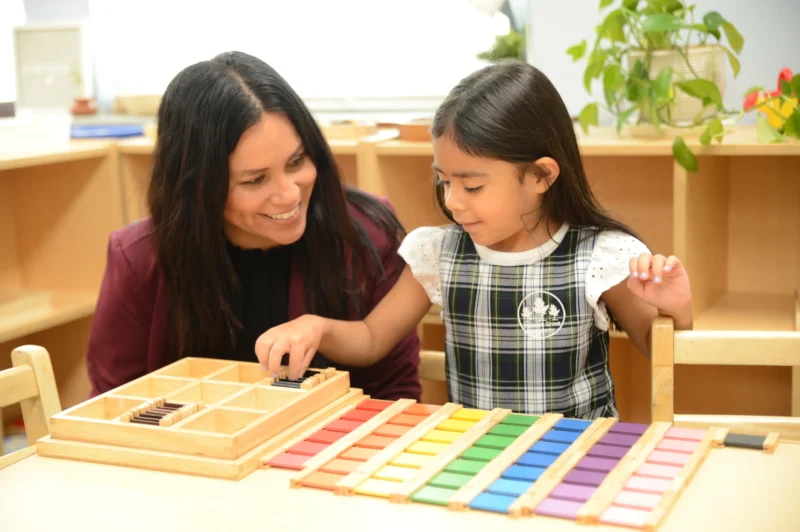
Instead of sorting children into single-age grades and teaching to the average, she built mixed-age classrooms — typically spanning three years. In a Montessori primary room, a just-turned-three-year-old, a four-year-old, and a nearly-six-year-old work in the same space. The age spread isn’t a problem to be managed. It’s the entire point.
The work is self-paced. A child moves to the next material when they’ve mastered the current one — not when the calendar says the whole class moves. The youngest child watches the oldest and absorbs what’s coming. The oldest consolidates their own understanding by helping the youngest. Nobody is held to the middle, because there is no middle to teach to.
We don’t teach to the average. We don’t teach to the lowest common denominator. We teach to the child in front of us — same room, same morning, different work.
In a classroom like that, a late-August birthday is not a disadvantage to be redshirted away. It’s just one more variation the room was designed to hold.
Our preschoolers don’t catch up to kindergarten. They walk in ahead of it.
What Kindergarten Readiness Actually Means
Here’s the part the September 1 cutoff can’t measure, and the part that actually predicts how a child will do.
Kindergarten readiness was never mostly about academics. It’s about whether a child can pause before reacting. Whether they can hold an instruction in their head and act on it. Whether they can try something, fail, and try a different way. Whether they can work at something on their own for more than a few minutes without an adult hovering.
Those are executive function skills, and they matter more for a kindergarten transition than knowing letters or numbers — because they’re the skills that let a child learn letters and numbers. A child who can regulate, focus, and persist will pick up academics fast. A child who can’t will struggle no matter how many flashcards they’ve seen.
And here’s the good news for the summer-birthday parent: those skills aren’t tied to a birthday. They’re built through practice — through exactly the kind of self-directed, hands-on, uninterrupted work a Montessori classroom is designed around. A younger child in the right environment can arrive at kindergarten with stronger executive function than an older child who spent a year being entertained.
That’s why we say your child’s birthday matters more than their IQ — but it matters less than the classroom you put them in.
Every Preschool Promises Kindergarten Readiness
Every preschool in San Antonio will tell you they get children ready for kindergarten. Most of them mean it. Most of them are teaching to the middle and hoping your child lands near it.
We ask a different question. Not is your child old enough. Not can we get them to the average. But: who is your child becoming — the September child and the August child both — when the classroom is finally built to meet them where they actually are?
We have four campuses across San Antonio: Spanish Grove Academy, Fair Oaks, NW Military, and Medical Center. Each one runs mixed-age, self-paced classrooms built on the simple premise that no calendar should decide what a child is ready for.
If your child has a summer birthday and you’ve been lying awake doing the math, come visit. Watch what happens in a room where the youngest child and the oldest child are both, at the same moment, doing exactly the work they’re ready for.
Stop stopping them.
Melissa Zamora is the Head of Schools at Edquisitive Montessori and the host of Conversations for the Beginning Years — a podcast and video series for parents and educators navigating the years that shape everything. Follow the series on Instagram @conversationsbeginningyears. More resources at the Parent Curiosity Hub.
Frequently Asked Questions
What is the kindergarten age cutoff in Texas?
Under the Texas Education Code, a child must be five years old on or before September 1 of the school year to be eligible to enroll in kindergarten. It is the single admission criterion — there is no state-mandated academic or developmental readiness assessment. A child who turns five on September 2 must wait a full year to enroll, while a child who turns five on September 1 may start that year.
Should I hold my summer-birthday child back from kindergarten (redshirt)?
The research is mixed. While relatively older children in a class often score higher early on (the “relative age effect”), studies using randomized data have found no reliable long-term test-score benefit to delaying entry — and some evidence that holding a ready child back can slow their learning by leaving them under-stimulated. Rather than defaulting to redshirting, the better question is whether the classroom you’re considering can meet your child at their actual developmental level, regardless of age. A mixed-age, self-paced environment removes much of the pressure that makes the birthday feel decisive.
What is the relative age effect?
The relative age effect is the documented tendency for children who are older relative to their classmates to outperform younger ones on academic measures — and, in some studies, to be judged more capable by teachers and chosen more often for leadership roles. It’s usually explained by maturity: older children in a single-age grade are simply further along in cognitive and social development, and a curriculum aimed at the class average tends to favor them. The effect is most pronounced in the youngest students and can persist for years.
How do I know if my child is ready for kindergarten?
Kindergarten readiness is less about academics and more about executive function — the ability to pause before reacting, hold and follow instructions, persist through frustration, and work independently for a stretch of time. These skills predict how well a child will adapt far better than whether they already know their letters. They’re built through practice, not birthdays, which is why a younger child in a strong environment can arrive more ready than an older child who wasn’t challenged.
How do mixed-age Montessori classrooms help with the age gap?
Mixed-age classrooms — typically spanning three years — remove the single-age “average” that the relative age effect depends on. Because work is self-paced, each child advances when they’ve mastered a material rather than when the calendar moves the whole class. Younger children learn by observing older ones; older children consolidate their understanding by helping. A summer birthday stops being a disadvantage because the classroom is designed to hold a wide range of ages and abilities at once, meeting each child where they actually are.
Does Montessori prepare children for kindergarten?
Yes — and often beyond it. Because Montessori children work at their own pace with materials designed to build focus, independence, and problem-solving, many arrive at kindergarten already doing what the grade is asking of them. The goal isn’t to help a child “catch up” to a standard, but to let each child progress as far as they’re ready to go, so the transition to kindergarten is a continuation of momentum rather than a cliff.
Want to See This in a Real Classroom?
If your child has a summer birthday and you’ve been weighing whether to wait a year, the most useful thing you can do is watch a mixed-age classroom in motion.
Come see a room where a just-turned-three-year-old and a nearly-six-year-old are both, at the same moment, doing exactly the work they’re ready for — because no one is teaching to the middle.
Schedule a Tour
Follow @edquisitivemontessori on Instagram
Explore the Parent Curiosity Hub
Related Reading
Executive Function in Preschoolers: The Skill That Matters Most | How to Raise Independent Children: Beyond the Rescue | Benefits of Montessori Education for Young Children | The Courage Conversation