A mom sat across from me last spring, phone face-down on the table, and asked the question I hear more than almost any other on a tour. “If we do two languages, are we going to mess up her English?” Her daughter was three, chatty, the kind of kid who narrates her own snack. And I understood the worry completely — it’s the worry underneath every browser tab open at the kitchen table at nine o’clock at night, the one that doesn’t quite fit into the contact form.
I’ve been in early childhood education for twenty-five years, and I want to answer that question honestly — not with a sales pitch, but with what I’ve actually watched happen in classrooms full of two-, three-, and four-year-olds learning two languages at once. Because “bilingual Montessori” gets printed on a lot of San Antonio preschool websites, and the phrase alone doesn’t tell you whether it’s real or whether it’s marketing. Let me walk you through how to tell the difference, and how to decide whether it’s right for your child.
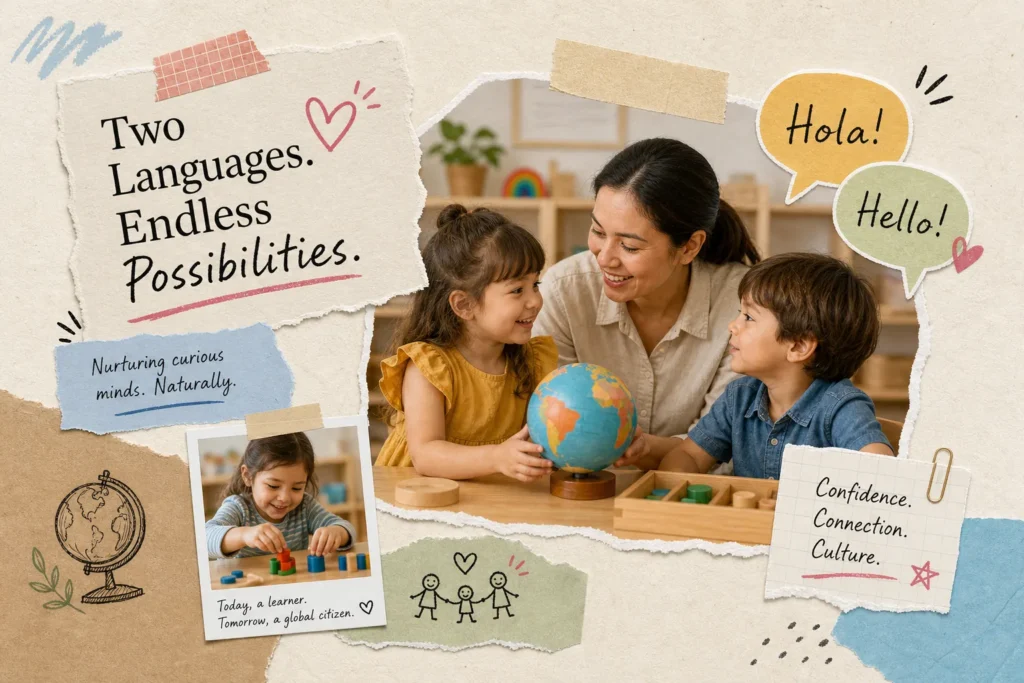
The short answer
For most curious, adaptable children, a bilingual Montessori preschool is an excellent fit — and in a bilingual city like San Antonio, it’s a genuine head start. But the quality of the program matters far more than the word “bilingual” on the sign. The rest of this is how to read that quality, and how to know if your child is one of the ones it suits.
First, the worry I hear most: “Won’t two languages confuse her?”
Let me put this one to rest, because I’ve watched it play out hundreds of times. Bilingual children sometimes have a slightly smaller vocabulary in each individual language than a single-language child the same age. Parents notice this and panic. But here’s what the panic misses: when you count both languages together, the total is right where it should be. The child isn’t behind. The words are just distributed across two systems instead of one.
That temporary gap is normal, it’s expected, and it is not a delay. In all my years I have never once seen two languages “confuse” a healthy child into a speech problem. What I have seen is the opposite — children who, by kindergarten, switch between Spanish and English mid-sentence without even noticing they’re doing it. What actually matters isn’t the number of languages. It’s the quality and consistency of the language a child hears every single day. That’s the thing to evaluate.
Why Montessori and a second language fit together so naturally
You can bolt a second language onto any classroom. But Montessori is different, because the method already works the way young children absorb language — through real things and real actions, not worksheets.
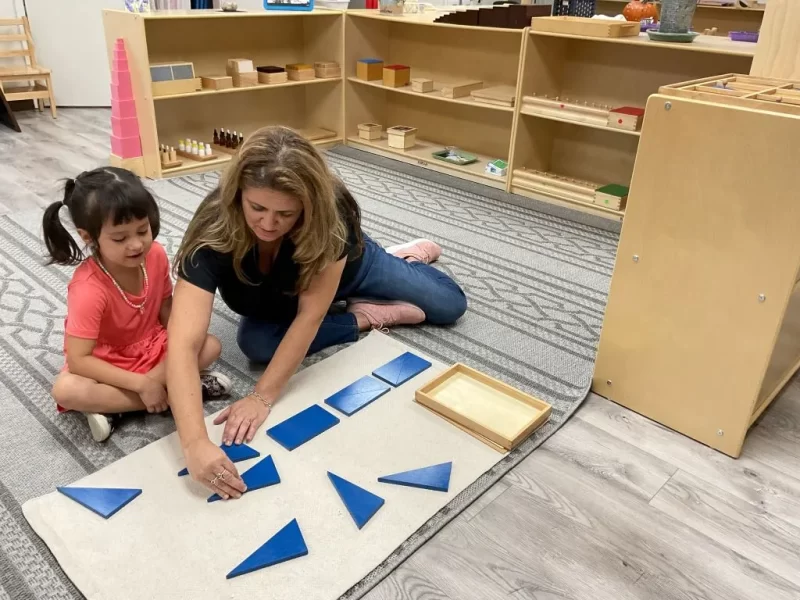
Here’s what I mean. A child picks up a small pitcher — la jarra — fills it with water, and pours it carefully into a glass. The word sticks because it’s attached to something her hands are doing, not to a flashcard she’s being quizzed on. All day, our practical-life materials, our bilingual books, our matching cards, our cultural work create these little moments where a Spanish word lands because it means something. That’s how real language is learned: meaning first, vocabulary second.
And then there’s the mixed-age classroom, which is honestly my favorite part. When a four-year-old shows a two-year-old how to do the spooning work, she’s modeling language at exactly the level the younger child can absorb — better, sometimes, than I could. Our teachers guide rather than lecture, which means a child learning Spanish gets the thing she needs most: time to listen and absorb before anyone expects her to speak. For a little one still finding her footing in a second language, that breathing room is everything. You can read more about how this looks day to day on our bilingualism page.
Immersion vs. dual-language: know which one you’re touring
When you tour bilingual programs around San Antonio, you’ll run into two very different models, and most websites won’t tell you which one they actually run. The difference shapes your child’s whole day.
In a full immersion program, most of the day — often nearly all of it — happens in Spanish, with English in the background. Children adjust over a few weeks, usually with a quiet period at first where they’re listening hard before they start producing words. It’s a deep path toward fluency, and it suits naturally adaptable children and families committed to that depth.
At Edquisitive, we run a balanced dual-language model — roughly 50-50. Both Spanish and English get deliberate, comparable attention through the day. The reason we built it this way is simple: we want children developing strong Spanish and strong English at the same time, not trading one for the other. For families who want real bilingual development but also want their child building confident English academic language from the start, that balance is the sweet spot. If you’re weighing a program that calls itself dual-language, ask exactly how the day splits — and whether the Spanish shows up during real Montessori work time, not just at circle.
How to spot a quality bilingual program (not just a labeled one)
Knowing the theory is one thing. Walking in and recognizing the real deal is another. Three markers tell you most of what you need to know.
Are the teachers native speakers?
This one matters more than parents realize. A teacher who grew up speaking Spanish and a teacher who learned it later bring genuinely different things into a classroom where children are absorbing language by ear all day. Native pronunciation, natural rhythm, the cultural context that comes woven into the words — you can’t fully fake those. At Edquisitive, our Spanish-speaking teachers are native speakers. When you tour anywhere, ask the question directly: are the lead teachers native or fully fluent? You’ll learn a lot from how quickly they answer.
What’s the program been measured against?
Anyone can say they’re high-quality. Outside review is what backs it up. Cognia accreditation means a program has been held to internationally recognized standards for curriculum, teaching, and child outcomes — it’s a serious external process, not a participation badge. A Texas Rising Star 4-Star rating is the highest level of our state’s quality-rating system, judged on a separate and equally rigorous set of benchmarks. Our campuses hold both. When a school has been scrutinized from two independent directions and passed, that tells you something a brochure can’t.
What’s actually included?
Ask what’s bundled into tuition and what’s billed separately, because “enrichment included” means very different things at different schools. At Edquisitive, the bilingual Spanish work lives inside the daily Montessori experience alongside yoga, music, our movement lab, science, and chef-prepared meals — all part of standard tuition, no surprise line items added later. That bundling is worth asking about everywhere you tour; separate enrichment fees add up fast and quietly change the real price comparison.
The questions I’d bring on a tour
If you were my friend and I were whispering in your ear before you walked in, these are what I’d tell you to ask:
- What percentage of the day is in Spanish, and how is that maintained during work periods — not just circle time?
- Are the classroom materials themselves labeled or presented in both languages?
- Are the lead teachers native or fully fluent Spanish speakers?
- What’s the adult-to-child ratio, and how many adults in the room are bilingual?
- Can I watch a classroom in session, not just see an empty room?
- What does a typical Tuesday morning actually look like for a three-year-old here?
For more on what to look for on any preschool visit, our preschool tour guide and our Montessori education FAQ are good things to read the night before.
Is it right for your child?
Honestly? For most children, yes — especially the curious ones, and especially in a city like ours where being bilingual is woven into daily life. It’s a particularly lovely fit for families new to San Antonio who want their child inside that bilingual culture from day one.
But I won’t tell you it’s right for every single child, because that wouldn’t be true. A little one with an active speech or language concern may need a different kind of support in place first — and if you have any doubt at all, a conversation with your pediatrician or a speech-language pathologist is worth having before you decide. That’s not a reason to rule it out. It’s just a reason to choose with your eyes open.
Here’s the truest thing I can tell you after twenty-five years: you’ll learn more in forty-five minutes of watching a real classroom than from any website, including ours. Watch the children during work time. Are they calm and absorbed, or restless? Listen for both languages used naturally, not performed for your benefit. Trust what you see. You’re already asking exactly the right questions — and that instinct is going to serve your child well.
Come see it for yourself
If a bilingual Montessori preschool sounds like it might fit your family, the best next step is simple: come watch a classroom in motion. We’d love to show you around any of our San Antonio and Boerne campuses — bring your questions.
Still deciding whether this is the right path for your family? Our guide on whether a bilingual Montessori preschool is right for your child walks through the speech-delay question, how dual-language compares to immersion, and what to ask on a tour.
For a parent’s-eye walkthrough of choosing a bilingual program, see Is a Bilingual Montessori Preschool Right for Your Child? — including how our balanced 50-50 dual-language model works day to day.
If you want to go deeper on how the two models compare and how our dual-language approach works in practice, our Spanish Immersion Montessori FAQ for San Antonio preschools answers the questions families ask most.