
Last Updated: July 2026 · Reviewed by Melissa Zamora, Head of Schools at Edquisitive Montessori, with 25 years of AMI and AMS Montessori experience in early childhood education.
In most cases, daycare and childcare mean the same thing. Childcare is the broader term. It includes daycare centers, home-based care, nannies, and family caregivers. Daycare usually refers to care provided at a licensed center during daytime working hours. All daycare is childcare, but not all childcare is daycare.
You’re searching for care and keep running into different words: daycare, childcare, preschool, early childhood education. Are these actually different things? Does it matter what you call it? Here’s what each term means, why early childhood professionals have opinions about them, and how to move from “what do these words mean” to “which option is right for my child.”
The umbrella term — includes all of these
Daycare refers to center-based or home-based programs that care for children during daytime hours while parents work. It typically means a licensed setting with set hours, group classrooms organized by age, multiple staff members, and a daily schedule. In everyday conversation, “daycare” is the word most parents reach for first, and it covers everything from large centers to small licensed home programs.
Childcare is the broad, umbrella term for any arrangement that cares for a child while a parent is unavailable. That includes daycare centers, licensed home-based family childcare, nannies and au pairs in your own home, and informal care from grandparents or family. Every daycare is a form of childcare. Not every form of childcare is a daycare. When professionals and licensing agencies write about the field, “childcare” (or “child care”) is usually the preferred term.
Here’s the distinction at a glance:
| Daycare | Childcare |
|---|---|
| A specific type of care | The umbrella term for all care |
| Usually a licensed center or home program | Includes centers, homes, nannies, family |
| Group setting, organized by age | Can be group or one-on-one |
| Set daytime working hours | Hours vary by arrangement |
| Often includes a curriculum | Educational depth varies widely |
If you’ve toured programs or talked with early childhood educators, you may have noticed some hesitation around the word “daycare.” It isn’t just semantics. The word “daycare” emphasizes when care happens rather than what happens, which can feel dismissive of the real education work happening in quality programs. “Childcare” or “early childhood education” better conveys that programs care for the whole child — physical, emotional, social, and cognitive — and that learning happens from birth, not just starting at age 5.
Saying “daycare” is like telling a professional chef they just make food. Technically accurate, but it misses everything that makes their work meaningful.
The National Association for the Education of Young Children (NAEYC) encourages using “child care” or “early learning programs” because these terms better reflect what dedicated educators actually do. That said, most parents use these words interchangeably, and there’s nothing wrong with that. What matters far more than terminology is finding quality care for your child.
This is where it gets fuzzy, because the terms overlap. Traditionally, “preschool” meant education-focused programs for ages 3 to 5, often on half-day or school-year-only schedules. “Daycare” meant full-day supervision for a wider age range, year-round. In practice today, many programs blend both. A quality daycare serving 4-year-olds likely includes kindergarten-readiness curriculum, and a preschool offering full-day care functions much like daycare for working parents.
What actually matters: Is there an intentional curriculum? Are teachers trained in child development? Does the program support your child’s growth across all areas? Does the schedule work for your family? Don’t get hung up on what a program calls itself. Look at what it actually does.
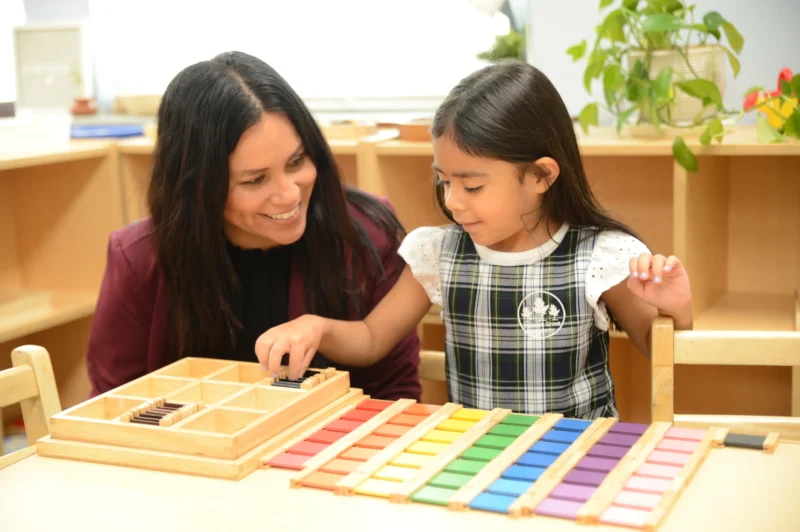
Montessori is an educational philosophy and approach, not a type of care setting. You can find Montessori preschools (half-day, school-year programs), Montessori childcare centers (full-day, year-round), and Montessori-inspired home daycares. The method emphasizes child-led learning within a prepared environment, mixed-age classrooms, hands-on materials with specific developmental purposes, independence and practical life skills, and intrinsic motivation over external rewards. A Montessori program can fully meet your childcare needs while providing a distinctive educational approach.
Instead of getting caught up in terminology, focus on these questions when evaluating any program:
Once the terminology is clear, most parents move on to the same set of questions. These guides pick up where this one leaves off:
We’re a Montessori early learning center, but we function as full-service childcare for working families — the convenience and full-day hours you need, with the educational depth your child deserves.
Authentic Montessori curriculum with inquiry-based learning, Spanish immersion included at no extra cost, enrichment programs (yoga, music, STEM) built into tuition, Cognia accredited and Texas Rising Star 4-Star rated, and freshly prepared meals by our on-site chef. We accept CCS and Military CCA.
Child care is the umbrella term covering all care arrangements: centers, nannies, family members, and more. Daycare is one specific type of child care, typically referring to center-based or home-based programs operating during daytime working hours. All daycare is child care, but not all child care is daycare.
The term “daycare” emphasizes when care happens (during the day) rather than what happens. It can feel dismissive of the education and development work happening in quality programs. “Child care” or “early childhood education” better reflects that programs do far more than supervision.
Traditionally, “preschool” meant education-focused programs for ages 3-5 with half-day or school-year schedules, while “daycare” meant full-day supervision for all ages. In practice today, many programs blend both. Focus on what the program actually provides rather than what it calls itself.
Montessori is an educational philosophy, not a type of care setting. You can find Montessori preschools (half-day programs), Montessori child care centers (full-day, year-round), and Montessori-inspired home daycares.
Focus on: teacher credentials and tenure, teacher-to-child ratios, whether there is an intentional curriculum, how the program supports development across all areas, licensing and accreditation status, communication practices with families, and whether the schedule works for your family.
Four main types: (1) Center-based care (licensed facilities with multiple classrooms), (2) Home-based or family child care (in a caregiver’s home, smaller groups), (3) In-home care (nannies, au pairs in your home), and (4) Informal care (grandparents, family, friends).
You don’t have to have it all figured out yet. Tell us a little about your child and what you’re looking for, and we’ll help you sort through the options — no pressure, no commitment.
Edquisitive Montessori operates four campuses across San Antonio and Boerne: Fair Oaks, Stone Oak (Spanish Grove Academy), Northwest Military, and Medical Center (Little Red Caboose). Cognia accredited. Texas Rising Star 4-Star rated.
A toddler meltdown in a store aisle feels like a parenting defeat. But learning to move through frustration, with a calm adult nearby, is part […]
News 4 San Antonio visited our Fair Oaks campus in Boerne this week to see the Curiosity Studios for themselves. The segment aired August 27 […]
Key Takeaways It’s 8:10 and you need to leave at 8:15. You’ve said “put your shoes on” four times. The shoes are right there. Your […]
“Be careful.” “Not like that — here, let me.” We give our children feedback all day long. But what is it actually teaching them? You’ve […]
But before we hand our children a lifetime of criticism in the name of love, there’s a distinction worth getting exactly right. Because the research […]
Key Takeaways Picture your room at 10:45 in the morning. Eighteen children. Three are mid-work. One just dumped the bead chain across the floor. Two […]
One approach, multiple neighborhoods—each with its own sense of community.