There’s no question I get more often, and no question with a worse reputation for straight answers. “When should my child start preschool?” Ask five sources and you’ll get five birthdays — three, three and a half, four, “whenever they’re potty trained,” “the earlier the better.” It’s enough to make any parent feel like they’re either rushing or already behind. So let me give you the honest version, from twenty-five years of watching children walk through the door for the first time.
The short answer: it’s less about age than you think
Most children start a formal preschool or Montessori primary program somewhere between two and a half and three. That’s the common window. But “the right age” is the wrong way to frame it, because I’ve watched two-year-olds settle in like they were born for it and three-and-a-half-year-olds who needed another couple of months. Age is where the conversation starts, not where it ends. What you’re really looking for is readiness — and readiness shows up as a pattern of small signs, never a single birthday.
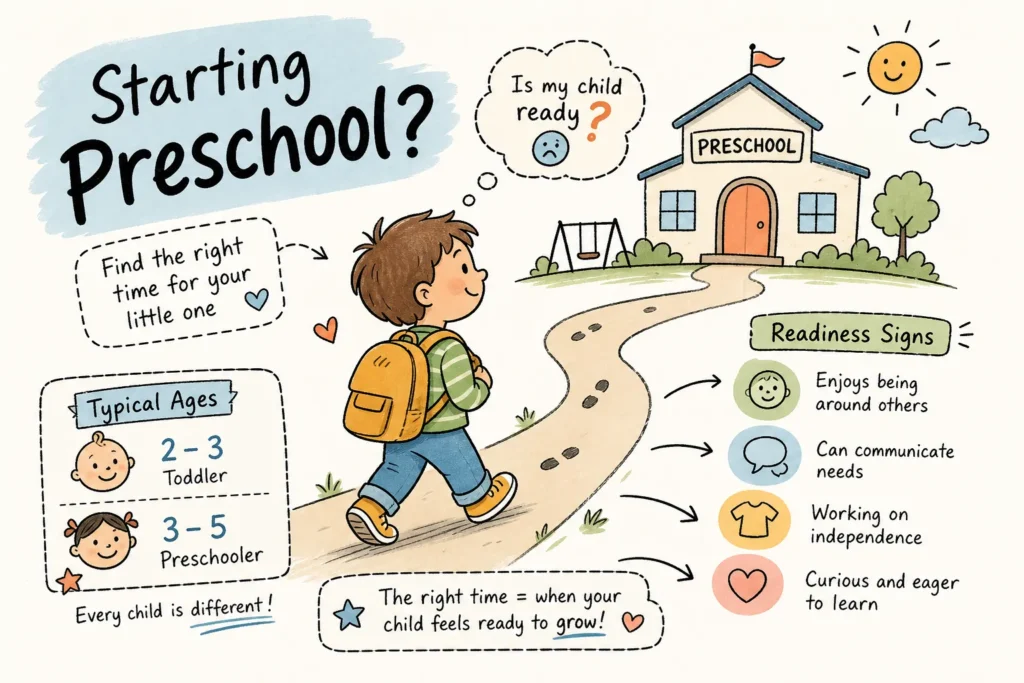
The signs that actually matter
Stop looking for one big milestone and start watching for a handful of quieter ones. No child shows all of them — that’s normal. But when several start appearing together, that’s your signal.
- They can handle short separations. Not without any tears ever — but they can be apart from you and recover, rather than staying inconsolable. A few minutes of upset at drop-off that fades is healthy.
- They’re curious about other children. Watching them, drifting toward them, trying to join in. That social pull is one of the clearest readiness cues there is.
- They can follow a simple direction. “Please put the cup on the table.” Two steps is even better. It means they can take in guidance and act on it.
- They can stay with something. A few minutes of focused attention on a puzzle, a book, a stacking toy. That capacity to engage is the seed of everything that happens in a classroom.
- They’re reaching for independence. Wanting to feed themselves, pull on a sock, wash their own hands — even badly. That “let me do it” drive is exactly what a good program builds on.
If you’re nodding at three or four of these, your child is very likely ready — whatever the calendar says.
“But she’s not potty trained yet”
This is the worry I hear most, so let me ease it right now. Potty training is not the gate everyone assumes it is. Plenty of quality programs — including Montessori programs that care for children from infancy — work with you on toilet learning rather than demanding it as the price of admission. At our campuses we follow each child’s own readiness cues and partner with families so the process stays consistent between home and school. So if that’s the only thing holding you back, it probably shouldn’t be. (Always ask each program directly, though — policies genuinely vary, and you deserve a clear answer.)
What if my child seems too young?
A lot of parents don’t realize that “preschool” and “care” aren’t the same starting line. Infant and toddler programs care for children from as early as ten weeks — focused on nurturing, movement, and sensory exploration, not academics. A formal preschool or Montessori primary classroom is a different stage that usually opens up around two and a half to three.
So if you’re looking at your one-year-old wondering whether they’re “too young for preschool,” the truer question is: which program matches where they are right now? There’s almost always a right setting for a child at every age — it just might not be the one with the word “preschool” on the door yet. You can see how the stages progress on our infant program and toddler program pages.
Starting at 3 vs. waiting until 4
Both work. The real question is which one works better for your specific child. Starting at three gives a child an extra year of routines, early language and vocabulary, and peer practice — and a child-paced environment like Montessori tends to handle younger starters gracefully, because the materials follow the child instead of forcing the child to follow a lesson plan. Waiting until four can be the wiser call for a child who still needs a lot of one-on-one reassurance, who hasn’t hit key social milestones yet, or who simply isn’t curious about leaving home. Choosing to wait isn’t a failure — it’s paying attention to what your child is telling you. The aim is a first experience that builds a love of school, not an early start that plants anxiety instead.
The program matters as much as the age
The same three-year-old can struggle in one classroom and flourish in another, which is why where deserves as much thought as when. The main approaches you’ll run into differ in one important way:
- Montessori — child-directed, with multi-age classrooms and self-paced materials that follow each child’s own readiness, so there’s no pressure to “keep up.”
- Reggio Emilia — an emergent approach driven by children’s own questions and observations, with a strong emphasis on collaboration.
- Play-based — builds social and cognitive development through free exploration and teacher-guided imaginative play.
If I could give you one question to carry into every tour, it’s this: does the program adapt to the child, or expect the child to adapt to the program? That single distinction shapes everything — how transitions are handled, how teachers respond when a child is struggling, whether an early start builds confidence or anxiety. For more on evaluating fit, our guide on how to know if a preschool is right for your child walks through what to watch for on a visit.
A gentle word about timing pressure
If I could take one weight off parents’ shoulders, it would be this: you are not behind. There’s no universal window slamming shut. Children who start at two and children who start at three both thrive — what matters far more than the month they began is whether the program fits and whether your child is met where they are. A child who cries at drop-off for the first two mornings and is tugging you toward the door by the third hasn’t started “too early” or “too late.” They’ve started in the right place.
When to actually start looking (and what to ask)
One practical note, separate from readiness: begin your search earlier than you’d think. I’d suggest researching programs 6 to 12 months before your intended start date. Quality programs fill up, and infant and toddler spots in particular tend to go first — so the family looking in spring for a fall start gives themselves room, while the one starting in August is often scrambling.
When you tour, come with real questions. The answers — and how openly they’re given — tell you as much as the classrooms do:
- What’s the teacher-to-child ratio?
- How do you handle the settling-in period for a new child?
- Do you offer gradual transition visits before the first full day?
- What’s included in tuition, and what costs extra?
A program that answers these openly and specifically is usually telling you something about its culture. Transparency at the tour stage tends to reflect what it’s like inside the classroom once you’re enrolled. (A brief, consistent goodbye ritual and a little practice with short separations beforehand go a long way, too — children read our calm, and steadiness is contagious.)
Start with your child, not the calendar
No date on a calendar resolves this question. What resolves it is watching your child — the curiosity, the communication, the small moments of independence and connection that signal a readiness no birthday can manufacture. Most children land in a genuine readiness window somewhere between two and a half and four, but the real goal is the right program, at the right time, for your child. Come visit any of our San Antonio and Boerne campuses, watch how your child responds to the room and the other children, and trust your gut. Our guide to what to ask on a preschool tour is a good thing to read first.