Every week, families across San Antonio tour preschools looking for the right fit for their child. They drive in from Stone Oak and Hollywood Park, from Shavano Park and Fair Oaks, from the Medical Center and the Babcock Road corridor — walking through classrooms, listening to tour scripts, and trying to read what they’re seeing.
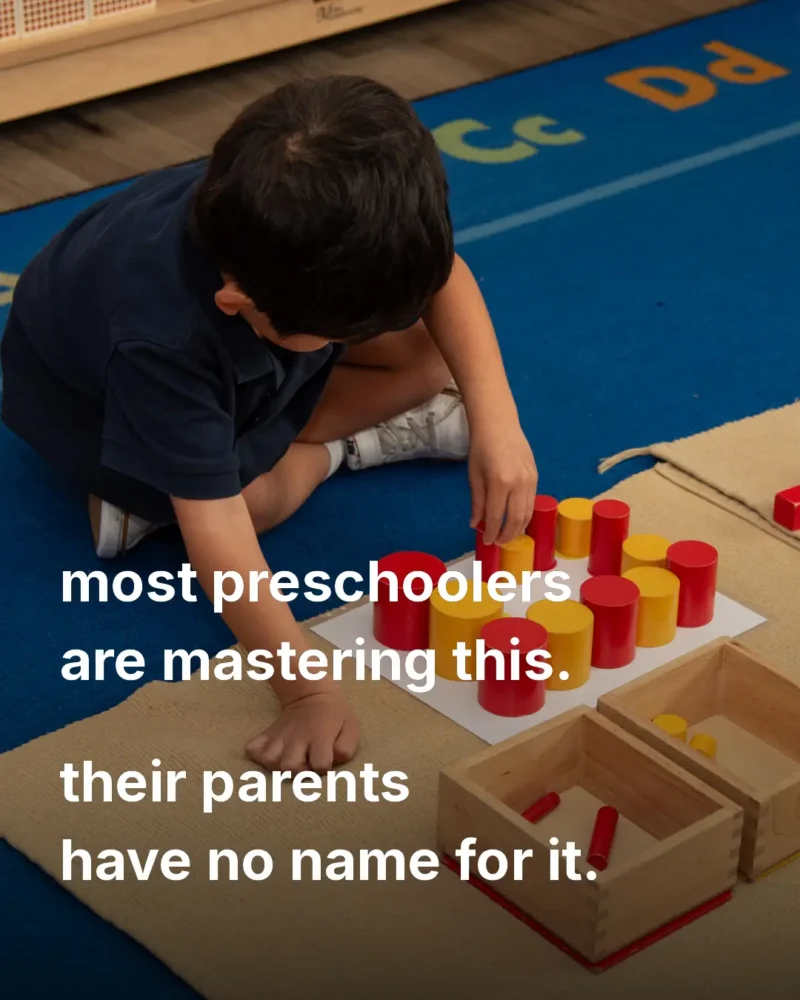
A mother stopped in our doorway last Tuesday morning. Her son was three. She had driven down from Encino Park to visit our primary classroom. He had been gripping her hand from the parking lot to the foyer, and then through the introduction at the front office. By the time we were walking into the Montessori work cycle in progress, his fingers were loose in hers. Two minutes after that, he let go entirely. He sat down on the floor next to another child who was pouring water from a small pitcher into a glass — a practical life material as old as Montessori itself. He didn’t say anything. He just watched.
The mother looked at me. I didn’t say anything either. There was nothing to say. She’d already gotten the answer.
I’ve been giving tours of Montessori classrooms across San Antonio for twenty-five years, and I’ll tell you what most schools won’t: the question isn’t whether the preschool is a good preschool. The question is whether your child is a good fit for this one. And the answer almost never comes from the brochure, the website, or the tour script. It comes from what your child does in the first five minutes inside a prepared environment.
This is what to actually watch for.

Forget the Brochure. Watch Your Child.
Every school has a brochure. Every brochure says caring teachers, individualized attention, kindergarten-ready, safe environment. After you’ve toured a few schools in San Antonio, the brochures start to sound the same. That’s because they are.
The brochure isn’t the data. Your child is the data.
When you walk into a Montessori-prepared environment — and a school worth your tuition will let you walk into a primary classroom, not just past it — watch your child’s body. Where do her eyes go first? Does she lean forward or pull back? Does her hand let go of yours? Does she take a step toward a material on a low shelf, or does she stare at the ceiling and the lights?
Children give themselves away in the first five minutes. Long before they’ve said a word about whether they like a place, their bodies have already told you. Most parents miss this signal because they’re concentrating on the tour guide. The tour guide is trained. Your child is not.
The Classroom You Want Looks Quiet
A productive preschool classroom isn’t silent. But it shouldn’t sound chaotic either. Most parents have an unconscious image of a “good” preschool that came from television — bright lights, music, twelve kids singing on the carpet, paint on every wall, everyone laughing at once. That’s a fine classroom. It’s also the kind of classroom that doesn’t build focus. And focus is what your child is going to need in NEISD or NISD kindergarten more than anything else.
In Montessori, this kind of focused quiet has a name: the work cycle. It’s a sustained, uninterrupted block — typically two and a half to three hours — when children choose their own work, stay with it as long as they need, and develop the concentration that future learning is built on. Look for movement with purpose. A child carrying a small tray across the room without spilling. Two children at a table, not talking, both absorbed. A guide kneeling next to one child for ten minutes at a time. A room where children are doing things, not being entertained.
If you walk into a preschool classroom and you can’t immediately tell which child the teacher is going to need to redirect next, that’s a good sign. The guide isn’t running the room. The prepared environment is running itself, and the guide is there to support it. That’s what authentic Montessori looks like.

A San Antonio Preschool Tour Checklist
Print this. Screenshot it. Bring it on every tour. It’s the short version of everything below — the signals to watch for before, during, and after a tour, organized so you can scan it in thirty seconds.
Before the Tour
- ✓ Bring your child if at all possible — their reaction is the most reliable data you’ll get.
- ✓ Schedule the tour during a regular work period, not nap, not pickup, not transition.
- ✓ Plan for at least forty-five minutes on site — anything shorter is a sales pitch, not a tour.
- ✓ Avoid scheduling back-to-back tours the same day. Your impressions blur.
During the Tour
- ✓ Watch your child’s body in the first five minutes. Where do their eyes go? Does the hand let go?
- ✓ Look for movement with purpose — children working, not being managed.
- ✓ Count how often the guide manages the whole room vs. works one-on-one with a child.
- ✓ Listen for calm focus, not chaos or constant adult redirection.
- ✓ Notice whether materials are accessible to children on low shelves, or locked away in cabinets.
- ✓ Check that the classroom is mixed-age (a Montessori hallmark) — three- to six-year-olds working alongside each other.
The Questions to Ask
- ✓ How long has your average teacher been here?
- ✓ What happens when a child has a hard morning?
- ✓ Can I see a regular work period, not an activity rotation?
- ✓ How do you decide a child is ready for the next classroom?
- ✓ What’s your turnover rate this year?
After the Tour
- ✓ Ask your child one question: “Did you want to stay there?” Then be quiet.
- ✓ Note their tone, not just their answer. Children give themselves away.
- ✓ Wait twenty-four hours before deciding. Emotion fades. The data persists.
- ✓ If you toured two or more campuses, compare your child’s body language across them — not the brochures.
Five Questions That Get Past the Sales Pitch
The tour guide is trained to answer questions about safety, ratios, curriculum, and price. Those questions matter, but you’ll get the rehearsed version. If you want the real answer, ask these instead. Each one is designed to surface what brochures hide.
1. How long has your average teacher been here?
The industry average for early childhood teacher turnover is north of thirty percent a year. A campus where teachers stay for five, ten, fifteen years is a fundamentally different place than one where the staff list looks different every September. At our Medical Center campus, our infant guide has been with us for twenty-eight years. That isn’t a number you can fake. Ask for specifics. Names. Years. If the school is proud, they’ll tell you.
2. What happens when a child has a hard morning?
The answer reveals more about the school than almost any other question. A confident, specific answer tells you they’ve handled this often and have a real approach — that the guides understand sensitive periods, separation, and the small storms of a three-year-old. A vague answer tells you what your child will get on her bad days.
3. Can I see a regular work period — not an activity rotation?
Schools that build focus have a long, uninterrupted Montessori work cycle, typically two or three hours, where children choose their own work and stay with it. This is the heart of the method. Schools that don’t have a work cycle fill the day with transitions and group instruction. You want to see the work, not the transitions.
4. How do you decide a child is ready to move to the next classroom?
Listen for what they describe. If they describe a chronological age, the school moves children by birthday. If they describe specific developmental signals — readiness for sustained work, social skills, independence at the bathroom — the school is watching the child. Authentic Montessori classrooms are mixed-age by design (infants, toddlers, primary), and the transition between rooms is based on the child, not the calendar.
5. What’s your turnover rate this year?
If they hesitate, you have your answer.
Watch How They Answer
Polished answers aren’t the answers you want. Specific ones are.
When a school is doing real work, the answers come back with names — of guides, of children, of moments. When a school is selling, the answers come back with adjectives and policies. The best tours I’ve ever given involved more standing still and watching than walking and talking. The worst ones I’ve ever been on as a parent involved more glossy phrases than substance.
If you ask a school how they handle separation anxiety, the answer you want sounds like, “Last month we had a little girl named Sophie whose first three days were rough — here’s what we did, and here’s what worked.” The answer you don’t want sounds like, “We have a comprehensive transition philosophy that emphasizes…”
Specific. Named. Real. That’s the answer of a school doing the work.
Your Child’s Reaction Is the Final Word
After every tour, ask your child one question, and then be quiet long enough to hear the answer.
“Did you want to stay there?”
If she says yes, you’ve found one. If she says no — even after a school that looked perfect on paper — listen. Children give themselves away in the first five minutes, and they tell you the truth in the last one.
The mother in our doorway last Tuesday already had her son’s answer before she had hers. He let go of her hand. He sat down next to another child. He watched water being poured into a glass. They drove back to Encino Park that afternoon, and the next morning she called to enroll.
When you find the right place, you’ll know because your child told you before you got there. Stop stopping them. Let them tell you.
Melissa Zamora is the Head of Schools at Edquisitive Montessori — a Cognia-accredited, Texas Rising Star Montessori organization with four campuses across San Antonio: Spanish Grove Academy (Stone Oak), NW Military / Shavano Park, Fair Oaks / Boerne, and Little Red Caboose (Medical Center). Melissa hosts Conversations for the Beginning Years — a podcast and video series for parents and educators navigating the years that shape everything. Follow on Instagram @conversationsbeginningyears. More resources at the Parent Curiosity Hub.
Schedule a Tour
Pick the campus closest to your family. We’ll send tour times right here on this page.
Thanks,
Pick a tour time below.
A few minutes is all it takes to see if this is the right place for your child.
Loading calendar…
Calendar not loading? Open booking page →
Frequently Asked Questions
How do I know if a preschool is the right fit for my child?
The clearest signal isn’t on the website or the tour script — it’s your child’s body in the first five minutes inside the classroom. Children let go of your hand, lean forward, and step toward something interesting when a place feels right. They tense up, look at the ceiling, or grip you harder when it doesn’t. Long before they have language for whether they like a place, their bodies have already decided. Pair that signal with what you observe in the prepared environment — calm focus, purposeful movement, a guide kneeling with one child at a time — and you have your answer.
What should I look for during a preschool tour in San Antonio?
Watch the children, not the tour guide. Look for movement with purpose — children carrying real materials, working at tables without constant adult prompting, and teachers spending sustained time with one or two children rather than managing the whole room. In a Montessori classroom, this is the work cycle in action. A productive preschool classroom isn’t silent, but it shouldn’t sound chaotic. Calm focus is the signal that the room is building the skills children need for NEISD or NISD kindergarten, not just filling time until pickup.
What questions should I ask on a preschool tour?
Skip the rehearsed questions. Ask: How long has your average teacher been here? What happens when a child has a hard morning? Can I see a regular work period — not an activity rotation? How do you decide a child is ready for the next classroom? What’s your turnover rate this year? The answers to these questions reveal more about a school’s real operation than any brochure or rehearsed pitch. Specific answers with names of teachers and children mean the school is doing the work. Glossy adjectives and “comprehensive philosophies” usually mean it isn’t.
Should I trust my child’s reaction to a preschool?
Yes — within reason. After every tour, ask your child one simple question: “Did you want to stay there?” Then be quiet long enough to hear the answer. A child who lights up about a place and asks to come back is telling you something. A child who pulls away or seems anxious after a school that looked perfect on paper is telling you something different. Their reaction isn’t the only data point, but it’s a real one. Most parents over-trust the brochure and under-trust their child.
What makes a Montessori classroom different from other preschools?
Three structural things. First, the work cycle — a long, uninterrupted block of two to three hours where children choose their own activity and stay with it. Second, the prepared environment — a classroom designed so children can independently reach materials, complete a full activity, and return everything to its place. Third, mixed-age classrooms — three- to six-year-olds working together so older children model focus and younger ones learn from observation. Authentic Montessori preschools across San Antonio share these structural features; the schools selling “Montessori-inspired” usually only borrow the vocabulary.
Related Reading
Benefits of Montessori Education for Young Children | Kindergarten Readiness Guide for San Antonio Families | Bilingual Development in Early Childhood | The Parent Curiosity Hub