Key Takeaways
- The simplest-looking activities of early childhood — scooping sand, pouring water, stretching rubber bands — are almost never about the activity itself. They’re building the child.
- Every experience has two layers: the visible task, and the concentration, coordination, patience, and problem-solving it’s quietly developing underneath.
- Children repeat the same activity to reach mastery, not because they’re bored. Real confidence grows from competence — not from praise.
- The most important milestones of these years are often invisible: working independently, self-correcting, persisting after a spill, cleaning up unprompted.
- A better question than “What did you learn today?” is “What is this helping you become?”
- Look past the activity to what a child is practicing, discovering, and becoming — and the most ordinary moments turn out to be extraordinary.
Walk into almost any early childhood classroom and you’ll see children doing ordinary things. Scooping sand from one bowl into another. Pouring water. Carrying a tray across the room. Stretching rubber bands around a wooden board. Building a tower, knocking it down, and building it again.
At first glance, it can look surprisingly simple — simple enough that a watching parent sometimes wonders, quietly, whether their child is really being challenged. It’s a fair thing to wonder. We’re trained to judge learning by what we can see: the finished worksheet, the new word, the thing held up to show us.
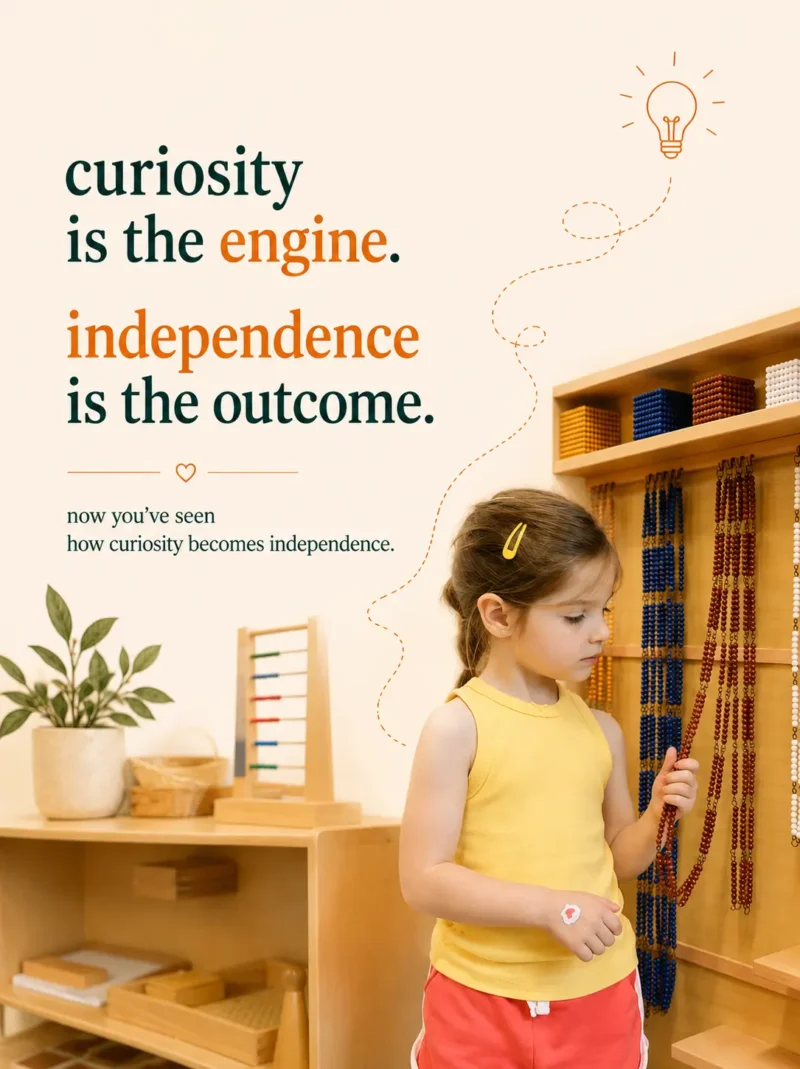
But early childhood works differently. A young child at work isn’t just completing an activity. She’s building herself. To understand what preschoolers are really learning, you have to stop watching the activity and start watching the child. Most adults watch what children are doing. The people who spend their lives around this age learn to watch something else — what those children are becoming.
“Can I show you something most adults miss?”
The Hidden Curriculum: What Children Are Really Learning
Every meaningful learning experience has two layers. There’s the activity — the visible thing. And then there’s what the activity is quietly developing underneath it.
When a child carefully scoops sand from one container into another, the goal was never to move the sand. The goal is the concentration it demands, the hand control it refines, the coordination it builds, the patience it asks for, and the deep satisfaction of getting better at something through repetition. When the sand is poured back and the work is returned to the shelf, the sand is gone. The concentration stays. The skill has become part of the child.
The sand goes back on the shelf. The concentration doesn’t. That’s the hidden curriculum of early childhood — the real lesson is almost never the thing you can see.
It’s the same reason a child stretching rubber bands around a board isn’t really doing a craft. Those tiny, straining muscles in the hand are the very ones that will one day hold a pencil, button a shirt, and tie a shoe. And it’s why a child working her way through a maze of tape stretched between the furniture isn’t just playing a game. She’s rehearsing the oldest skill there is — meeting a problem and finding her own way through it.
Why Children Repeat the Same Thing Over and Over
Adults chase novelty. Children chase mastery.
A child may choose the exact same activity ten times in a single week — not because she’s bored, and not because she’s stuck, but because her brain is still laying down the pathways to do it with ease. Each repetition sharpens the precision a little more. Each success adds a small, quiet deposit of self-belief. Every “I did it!” becomes evidence, filed away somewhere, that a hard thing can be overcome.
That’s where real confidence comes from. Not from applause, and not from being told she’s smart. From competence — the felt experience of being able to do a real thing herself.
The Invisible Skills of Early Childhood
When we watch young children, it’s easy to look for the visible outcome. Did she finish? Did she make something? Did she learn a new word today? But some of the most important milestones of these years are invisible in the moment they happen.
A child who works on her own for fifteen unbroken minutes. A child who notices her own mistake and quietly fixes it, with no one watching. A child who spills the water, pauses, and reaches for the cloth instead of an adult. A child who carries her work back to the shelf without being reminded.
None of it looks remarkable. All of it is. Those small, unglamorous moments are concentration, self-regulation, resilience, and independence taking shape — the quiet machinery that will shape how this person meets the world long after preschool is a memory.
The most important milestones of early childhood rarely look like milestones at all. They look like a child, absorbed, doing something small — and finishing it herself.
A Better Question
At pickup, or at bedtime, most of us ask the same thing: “What did you learn today?” It’s a good question. But there may be a better one.
Not what did you learn — but what is this helping you become?
Because every meaningful childhood experience shapes far more than knowledge. It shapes habits. Mindsets. Confidence. Curiosity. Character. Facts can be looked up later, at any point in a whole long life. The rest of it — the disposition to try, to persist, to care — is being built right now, in these years, and most of it can’t be added in later.
Looking Beyond the Activity
You don’t need a classroom to see any of this. Whether you’re touring a school, sitting on the kitchen floor with a toddler, or watching your child puzzle over something in the backyard, try looking past the activity itself.
Instead of asking, “What is she doing?” — ask, “What is she practicing? What is she discovering? What is she becoming?”
It’s a small shift, and it changes almost everything about the way childhood looks. Once you begin to see the child instead of the task, you can’t stop noticing how much is happening inside the most ordinary moments — and how little of it is actually ordinary at all.
The Smallest Moments
The biggest lessons of childhood are almost always hidden inside the smallest moments. A scoop of sand. A stretched rubber band. A maze of tape on the floor. To an adult in a hurry, they look like nothing. To the child, they’re everything — and to anyone who slows down enough to really look, they’re a window into the whole person taking shape.
Most adults watch what children are doing. The people who love this age learn to watch who they’re becoming. Slow down, look a little closer, and children have an extraordinary amount to teach us.
Steve is an educator at edQuisitive Montessori in San Antonio, home of Curiosity Studios, where he spends his days observing what young children are really learning in the smallest moments of the day. [Add last name / title here if desired.]
Frequently Asked Questions
Why do preschool activities look so simple?
Because the visible activity is only half of what’s happening. Scooping sand or stretching rubber bands looks basic, but underneath it a child is building concentration, hand control, coordination, patience, and problem-solving. The simpler an activity looks, the more room it often leaves for that invisible developmental work — which is exactly the point.
Why does my child do the same activity over and over?
Repetition is how young children reach mastery. A child may choose the same work many times in a week because the brain is still building the pathways to do it with ease. Each repetition refines precision and adds a small measure of confidence — the felt sense of “I can do this myself.” It’s not boredom or being stuck; it’s the brain finishing a job.
What skills is my child building that I can’t see?
Some of the most important ones. A child who works independently for fifteen minutes, notices and fixes her own mistake, keeps going after a spill, or returns materials without being asked is developing concentration, self-regulation, resilience, and independence — the foundations of executive function that shape learning and behavior long after preschool.
What’s a better question than “What did you learn today?”
“What is this helping you become?” Knowledge can be added at almost any age, but habits, mindset, confidence, curiosity, and character are built in early childhood. Asking what an experience is helping a child become keeps the focus on the person taking shape, not just the visible output of the day.
How can I support this kind of learning at home?
Look past the activity. Instead of “What are you doing?” ask yourself “What is she practicing? What is she discovering? What is she becoming?” Give real tasks she could actually fail at, allow repetition, and resist stepping in the moment something gets hard — the struggle is where much of the growth happens.
See It for Yourself
The next time you’re with a young child — at home, at the park, or visiting a classroom — try watching for what they’re becoming instead of just what they’re doing. And if you’d like to see a whole environment built around that idea, come spend a morning in one of our San Antonio classrooms and watch the smallest moments up close.
Schedule a Visit
Follow @edquisitivemontessori on Instagram
Explore the Parent Curiosity Hub
Related Reading
Executive Function: The Most Important Skill of Preschool | Benefits of Montessori Education for Young Children | The Parent Curiosity Hub