San Antonio parents increasingly seek bilingual education options that prepare children for our interconnected, bilingual community. Spanish immersion and dual language Montessori programs offer powerful advantages—from enhanced cognitive development to cultural fluency—but many families have questions about how these programs work, their effectiveness, and which approach best fits their child. This comprehensive FAQ answers your top questions about bilingual Montessori education in San Antonio, drawing from decades of research and our experience at Spanish Grove Academy, one of San Antonio’s first dual-language Montessori programs (founded 2010).
💡 Important Distinction: This FAQ covers both Spanish immersion (90-100% Spanish instruction) and dual language (50% Spanish / 50% English) programs. These are different models with distinct approaches. Spanish Grove Academy uses a dual-language model, not pure Spanish immersion—an important distinction we’ll explain below.
San Antonio offers several bilingual preschool options, including Spanish immersion programs (90-100% Spanish) and dual-language programs (50/50 balance). For families seeking bilingual education combined with authentic Montessori methodology, look for programs with native Spanish-speaking teachers, proven educational approaches, and documented outcomes.
Dual-Language Montessori • Founded 2010 • One of San Antonio’s First
📍 Address: 22215 Wilderness Oak, San Antonio TX 78258
📞 Phone: (210) 390-1470
✉️ Email: stoneoak@edquisitive.com
🕐 Hours: Monday-Friday, 7am – 6pm
👶 Ages Served: 6 weeks – Pre-K
Why Spanish Grove Academy Stands Out:
✓ Founded 2010 — One of San Antonio’s first dual-language Montessori programs with 15+ years proven track record
✓ Cognia Accredited & Texas Rising Star 4-Star
✓ 50/50 Dual-Language Model (NOT pure Spanish immersion) — balanced English and Spanish daily
✓ Native Spanish-speaking teachers from Latin America
✓ Blended methodology: Montessori + Reggio Emilia + Waldorf approaches
✓ AMS member (American Montessori Society)
✓ Estrellita Spanish reading program for Pre-K (aligns with NEISD dual-language curriculum)
✓ Lakeshore theme boxes for hands-on, visual learning experiences
✓ Prepares students for NEISD dual-language elementary programs
✓ Cultural celebrations & Latin music/dance integrated throughout
Important: Spanish Grove Academy uses a dual-language model (50% Spanish / 50% English), not pure Spanish immersion. This balanced approach serves both English-speaking and Spanish-speaking families equally while preparing children for NEISD’s dual-language elementary programs.
Full Spanish immersion (90-100% Spanish), ages 6 weeks-5 years, play-based curriculum. Different from dual-language; minimal English instruction.
Two locations (Hollywood Park & Stone Oak), Spanish immersion model, play-based. Not Montessori methodology.
PreK-5, offers Spanish alongside French & Mandarin tracks. IB curriculum, not Montessori.
Spanish immersion with holistic early childhood approach.
Teachers should be native speakers from Spanish-speaking countries, providing authentic pronunciation and cultural perspectives
Program should clearly define whether it’s immersion (90/10) or dual-language (50/50) and explain how languages are used throughout the day
Best programs combine language with proven approaches like Montessori, Reggio Emilia, or IB curriculum—not just language drills
Authentic cultural celebrations, Latin American music/dance, and exposure to diverse Spanish-speaking cultures
Look for established programs (Spanish Grove Academy: founded 2010) that can show graduate success in dual-language elementary schools
Programs using Estrellita or similar curricula align with NEISD dual-language elementary, ensuring smooth transition
💡 Pro Tip: San Antonio’s NEISD (North East Independent School District) offers excellent dual-language elementary programs. If you plan to use NEISD schools, choose a preschool that specifically prepares for this transition—like Spanish Grove Academy, which uses the Estrellita reading program aligned with NEISD curriculum and has 15 years of experience preparing students for dual-language elementary success.
Spanish immersion and dual language are related but distinct approaches to bilingual education. Understanding the difference helps parents choose the right program for their child and family circumstances. This distinction is critical—programs using these terms interchangeably may not be accurately describing their approach.
Definition: Students spend the majority (typically 90-100%) of their school day learning entirely in Spanish. English is minimal or absent, especially in early years.
Best For: English-dominant homes wanting maximum Spanish exposure; families committed to full bilingualism; children who will continue to Spanish-majority elementary programs
San Antonio Examples: The Pineapple School, Bilingual Child Academy
Definition: Students receive balanced instruction in both Spanish and English throughout the day. Both languages are valued equally and used for academic content.
Best For: Families wanting both languages strengthened equally; Spanish-speaking homes wanting to maintain heritage language while building English; children entering NEISD dual-language elementary
San Antonio Examples: Spanish Grove Academy (Edquisitive Montessori)
| Feature | Spanish Immersion (90/10) | Dual Language (50/50) ✓ |
|---|---|---|
| Spanish Exposure | 90-100% of school day | 50% of school day |
| English Support | Minimal or gradual introduction | Equal from day one |
| Speed to Spanish Fluency | Faster (2-3 years) | Moderate (3-5 years) |
| English Development | May temporarily lag (catches up by 3rd grade) | Maintained throughout |
| Ideal for English-Only Homes | Yes, maximum Spanish exposure | Yes, balanced approach |
| Ideal for Spanish-Speaking Homes | Less common (child already has Spanish) | Excellent (builds English while maintaining Spanish) |
| NEISD Dual-Language Prep | Good preparation | Excellent — mirrors NEISD’s balanced model |
| Parent Anxiety | Higher (English-speaking parents may worry) | Lower (both languages visible and valued) |
When Spanish Grove Academy was founded in 2010 as one of San Antonio’s first dual-language Montessori programs, we deliberately chose the 50/50 dual-language model over pure Spanish immersion. Here’s why:
💡 Decision Framework: If Spanish is spoken at home → Dual language helps maintain Spanish while building English. If English is spoken at home → Both models work; immersion provides maximum Spanish exposure (faster fluency, temporary English lag), dual language provides balanced development (no English lag, moderate Spanish pace). Unsure? Schedule tours at both types of programs to see which philosophy resonates with your family.
No. This is the most common parent concern about bilingual education, and decades of research provides a clear answer: Learning a second language in early childhood does not confuse children or harm English development. In fact, bilingualism enhances cognitive development and often accelerates language skills in both languages.
Birth to age 6 is the “critical period” for language acquisition—what Maria Montessori called the “sensitive period for language.” During these years, children’s brains form neural pathways for language at an unprecedented rate. Research published in the National Library of Medicine confirms children aged 0-3 absorb and retain new languages effortlessly—without the conscious effort adults require.
Key Finding: A 2001 study in Spain found bilingual infants can differentiate between two languages as early as 4 months old. They naturally understand which language is which without confusion.
Decades of immersion research—dating back to 1960s Canadian French immersion programs—consistently show that children in language immersion programs perform as well or better on English standardized tests compared to English-only peers by 3rd-5th grade, despite receiving less English instruction.
Why This Happens: Learning a second language develops “metalinguistic awareness”—the ability to think about how language works. Bilingual children understand concepts like grammar, sentence structure, and vocabulary more deeply, which transfers to and strengthens their English abilities.
Some children in bilingual programs go through a “silent period” in the new language—listening and understanding but not speaking yet. This is completely normal and mirrors how infants learn their first language (comprehension precedes production).
Typical Timeline: Most children begin using Spanish words and phrases within 3-6 months of bilingual education. Fluent sentences develop by 12-18 months. At Spanish Grove Academy, our 50/50 dual-language model means English development continues normally at school (not just at home), so parents rarely observe any English delay.
The American Council on the Teaching of Foreign Languages (ACTFL), Center for Advanced Research on Language Acquisition (CARLA), and American Academy of Pediatrics all confirm: Early bilingual education provides cognitive, academic, and social advantages with no negative impact on English development. Any temporary differences in English vocabulary resolve by early elementary school, while the cognitive benefits of bilingualism last a lifetime.
Dual language education and Montessori methodology are a powerful combination. Both approaches emphasize natural learning, independence, and respect for the child’s developmental timeline—making them highly compatible and mutually reinforcing. At Spanish Grove Academy, we’ve blended Montessori with Reggio Emilia and Waldorf approaches since 2010, creating a uniquely effective bilingual learning environment.
Maria Montessori described children’s “absorbent mind”—the innate ability to absorb language from their environment like a sponge. She wrote extensively about how children naturally acquire whatever languages surround them without conscious effort. As Dr. Montessori observed: “What is clear is that when the child is born, he has neither hearing nor speech. So what exists? Nothing, yet all is ready to appear.”
Montessori education capitalizes on this by providing:
At Spanish Grove Academy, we don’t use just one approach—we blend the best of multiple proven methodologies:
The Result: Children experience a uniquely designed curriculum that combines multiple educational philosophies, all delivered by multilingual educators fluent in both Spanish and English.
Montessori education respects that each child develops at their own pace. This is crucial for bilingual development:
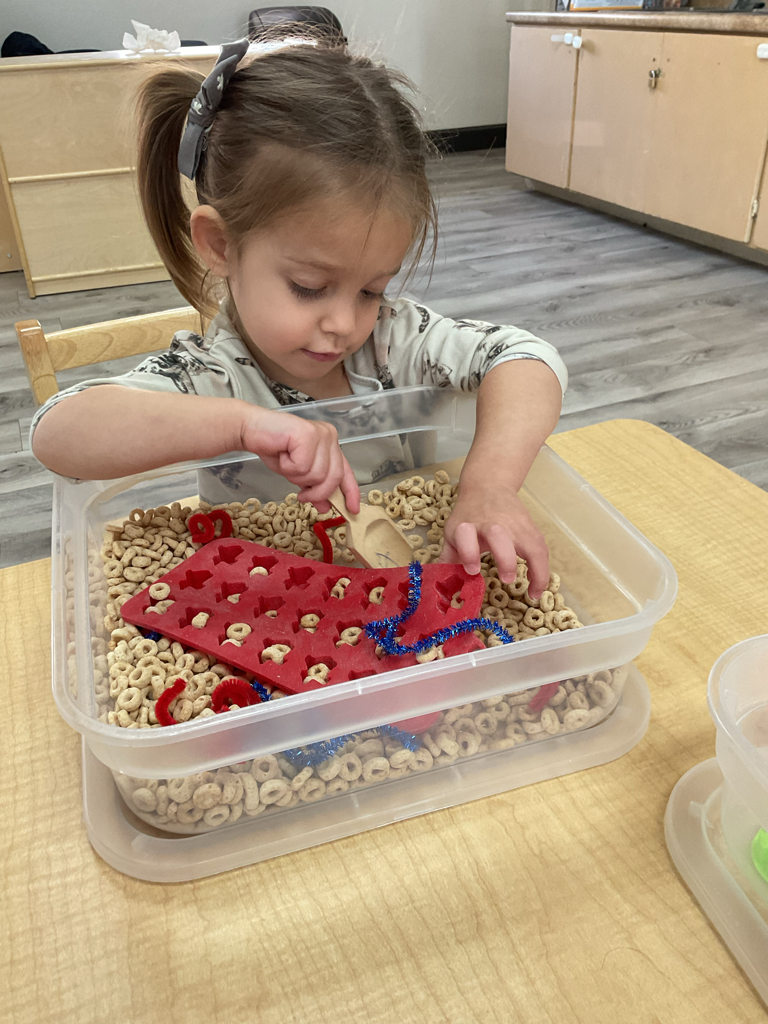
Pouring, spooning, washing tables taught with Spanish vocabulary: “Vierte el agua” (Pour the water), “Limpia la mesa” (Clean the table)
Color tablets: rojo, azul, amarillo. Sound boxes: fuerte, suave. Geometric solids: esfera, cubo, prisma
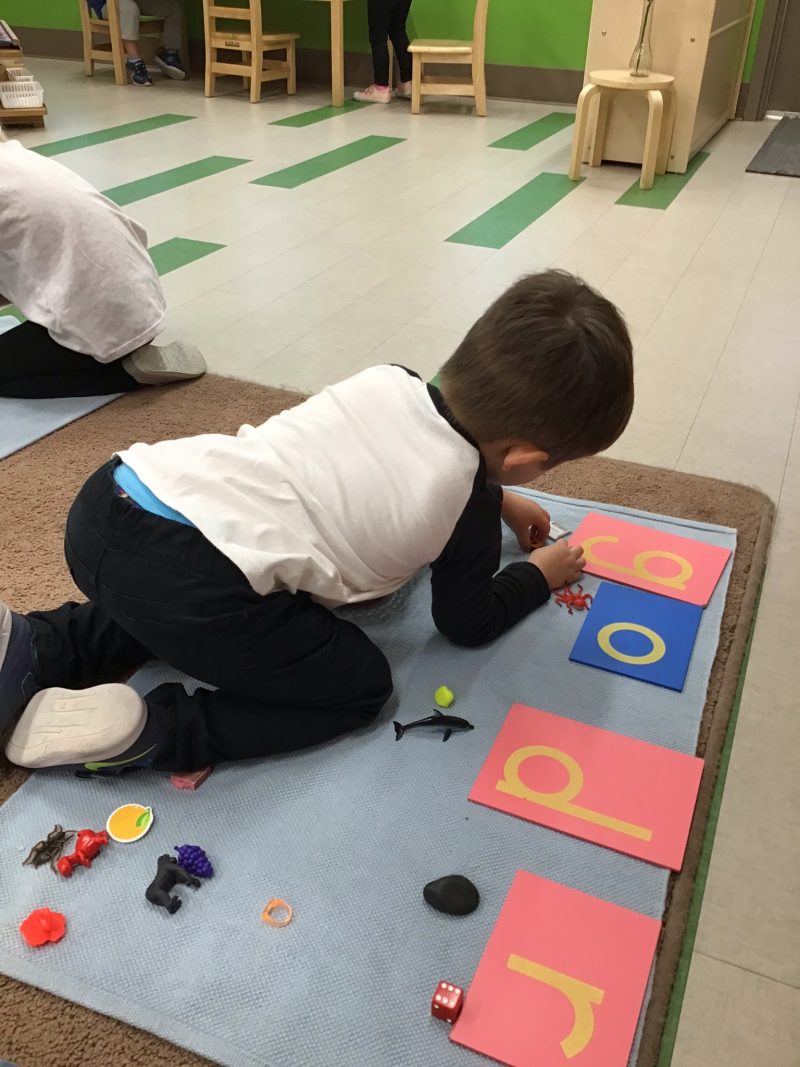
Moveable alphabet in Spanish (including ñ), Estrellita Spanish readers, bilingual vocabulary cards, cultural reading materials
Number rods: uno, dos, tres. Golden beads: unidad, decena, centena, millar. Math operations in both languages
Geography of Spanish-speaking countries, Latin American music and art, traditional celebrations (Día de los Muertos, Carnaval, Cinco de Mayo)
Comprehensive theme boxes with visual props and manipulatives for hands-on, thematic learning from math to dramatic play—presented bilingually
Many San Antonio families choose NEISD (North East Independent School District) for elementary school because of their acclaimed dual-language programs. Spanish Grove Academy specifically prepares children for this transition:
💡 The Result: Children at Spanish Grove Academy develop bilingualism naturally through the same hands-on, child-led Montessori work parents love—blended with Reggio Emilia’s project-based learning and Waldorf’s emphasis on imagination. Language learning isn’t a separate “add-on” activity; it’s seamlessly integrated into our uniquely designed curriculum.
Bilingual education provides profound cognitive, academic, social, and economic advantages that extend far beyond simply speaking two languages. Research consistently shows bilingual children outperform monolingual peers across multiple measures of cognitive development and academic achievement.
As we share with families at Spanish Grove Academy: “El bilingüismo es el mejor regalo que le puede dar a sus hijos” — Bilingualism is the best gift you can give your children.
Bilingual children have a higher density of grey matter in the brain. Grey matter processes information generated in the sensory organs. Children learn predominantly through their senses; thus, bilingual children have a more remarkable ability to process and sort through sensory input—a crucial advantage in Montessori’s sensorial-rich environment.
The saying goes, “The more neurons that fire together, wire together.” A bilingual child has an increased number of neurons firing together, leading to a healthier, more efficient brain. Research by Dr. Ellen Bialystok shows bilingual children excel at:
Speaking more than one language strengthens the brain’s dorsolateral prefrontal cortex, responsible for problem-solving. The increased neural plasticity of a bilingual child’s brain allows them to understand problems from many more angles—exactly the kind of flexible thinking we cultivate through Montessori and Reggio Emilia approaches at Spanish Grove Academy.
Bilingual children learn to “shut down” one language system to access the other, which develops the ability to filter distractions and focus more fully. Therefore, bilingual children can more easily focus on tasks and filter information efficiently—a critical skill for Montessori’s extended work periods and self-directed learning.
Bilingual children have a greater capacity for creative thinking due to the increased number of neural pathway connections activated in the brain. This allows children to see situations from many different angles, giving them greater awareness, understanding, and creative insight—qualities we nurture through our blended Montessori-Reggio-Waldorf approach.
Bilingual children are much more aware of the nuances and intonation of language, and more easily pick up on subtle cues of communication. They’ve had to hone their listening skills to decipher between languages, making them better listeners overall. Although bilingual children may take longer to speak initially, they develop more in-depth communication abilities later.
Bilingual children have been shown to have more effective social skills and are more open-minded and accepting of cultural differences. Communicating with different cultural groups builds confidence and develops cultural awareness, enhancing empathy and compassion for others—especially valuable in San Antonio’s diverse, bilingual community.
CARLA longitudinal studies show bilingual students outperform monolinguals in reading, math, and science by middle school. They graduate high school at higher rates (94% vs. 87%) and complete college more frequently.
Bilingual adults earn 5-20% more than monolingual peers, with premiums averaging $3,000-$7,000 annually. In San Antonio’s healthcare, military, and international business sectors, Spanish-English bilingualism is especially valued.
Bilingual adults develop Alzheimer’s symptoms 4-5 years later than monolinguals. Enhanced brain plasticity and cognitive reserve protect against age-related decline, with bilingual seniors maintaining sharper cognitive skills into their 80s.
“…it appears that when families have another language that can be spoken in the home where children are being raised, it could be an opportunity to both enrich their language skills and also provide a cognitive boost for their highest brain networks of executive functions.”
— Judy Willis, M.D., M.Ed.
Visit Spanish Grove Academy—one of San Antonio’s first dual-language Montessori programs since 2010. See our blended Montessori-Reggio-Waldorf approach in action with native Spanish-speaking teachers.
Schedule Your Free Tour →
Address: 22215 Wilderness Oak, San Antonio TX 78258
Phone: (210) 390-1470
Email: stoneoak@edquisitive.com
Ages: 6 weeks – Pre-K
Hours: Monday-Friday, 7am – 6pm
Credentials: Cognia Accredited • Texas Rising Star 4-Star • AMS Member • North American Reggio Emilia Alliance Member
Model: 50/50 Dual-Language (OTOL Method) — NOT Spanish Immersion
History: Founded 2010 — One of San Antonio’s First Dual-Language Montessori Programs
Curriculum: Blended Montessori + Reggio Emilia + Waldorf with Estrellita Spanish Reading
Also serving all San Antonio families at three additional Edquisitive Montessori campuses:
Fair Oaks (Boerne) • Northwest Military • Medical Center (Little Red Caboose)
Kindergarten registration is right around the corner—Boerne ISD, NISD, NEISD, and other San Antonio Area school districts opens enrollment in March 2026, and if you’re […]
Quick Answer: Is Elf on the Shelf Real? No, the Elf on the Shelf is not real. It’s a holiday tradition where parents move a […]
The Deep Work of Toddlerhood—And the Special Teachers It Demands If you’re a parent of a toddler, you know the feeling: they are non-stop. Their […]
One approach, multiple neighborhoods—each with its own sense of community.