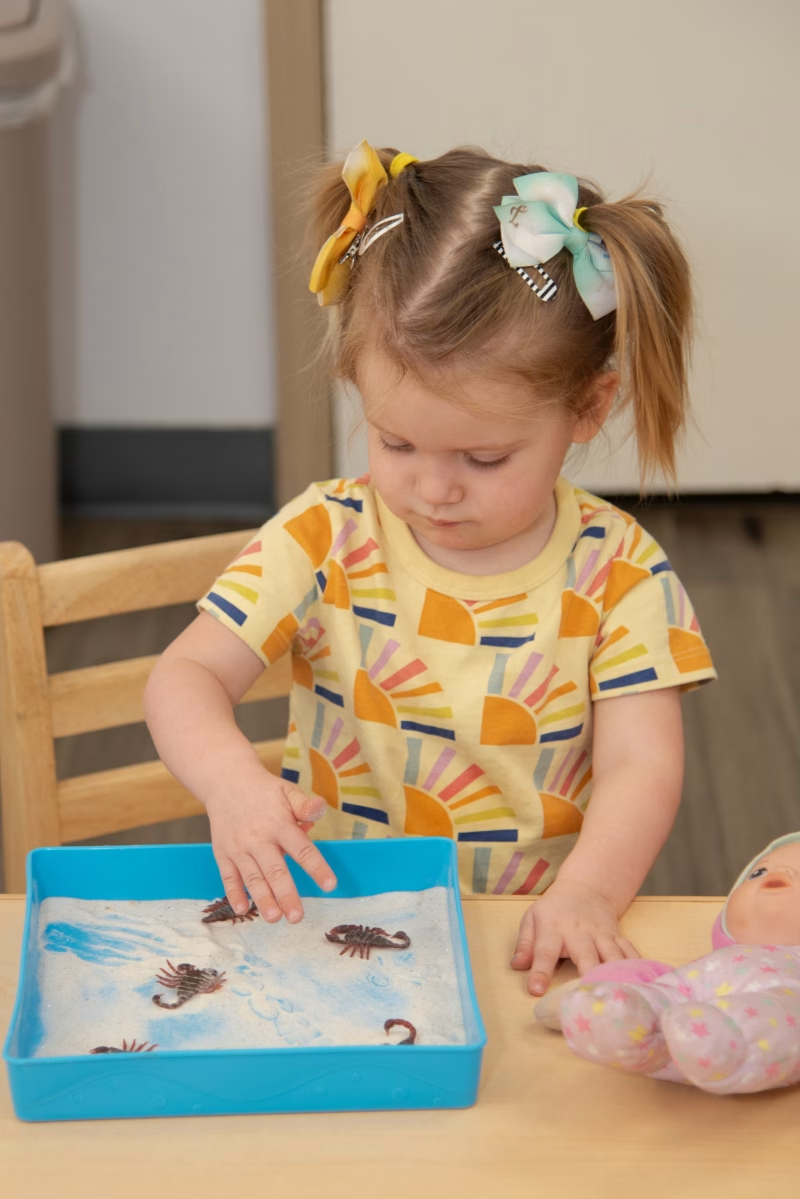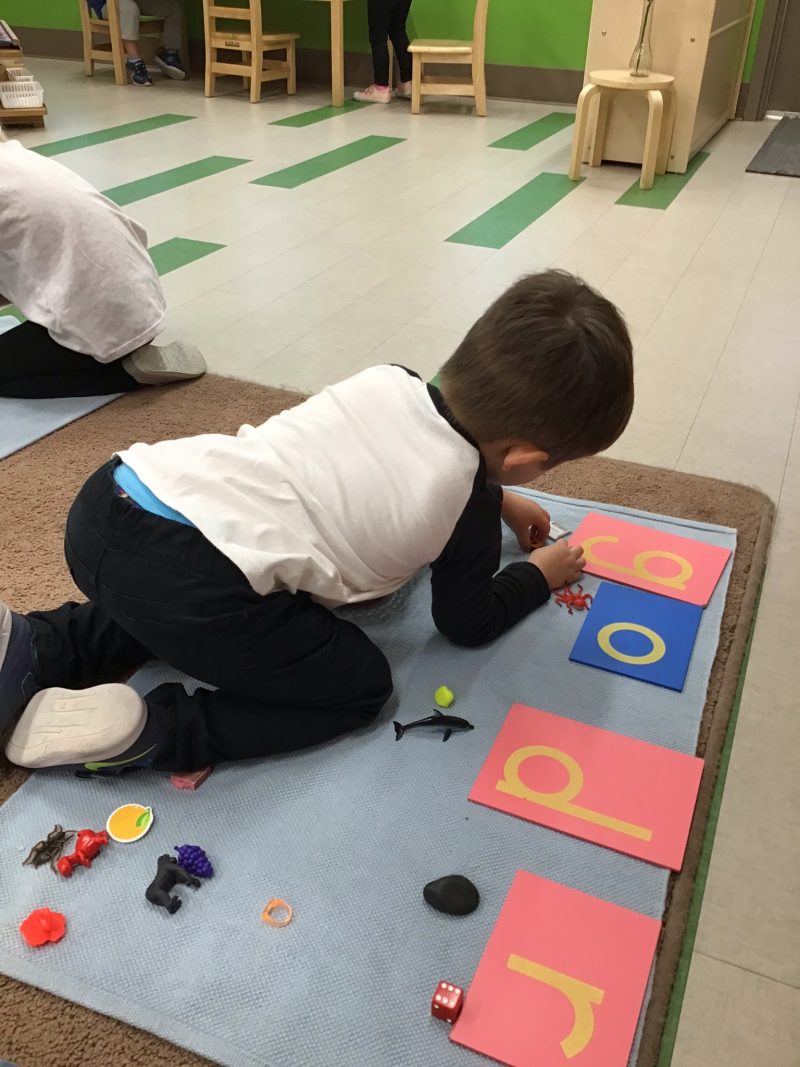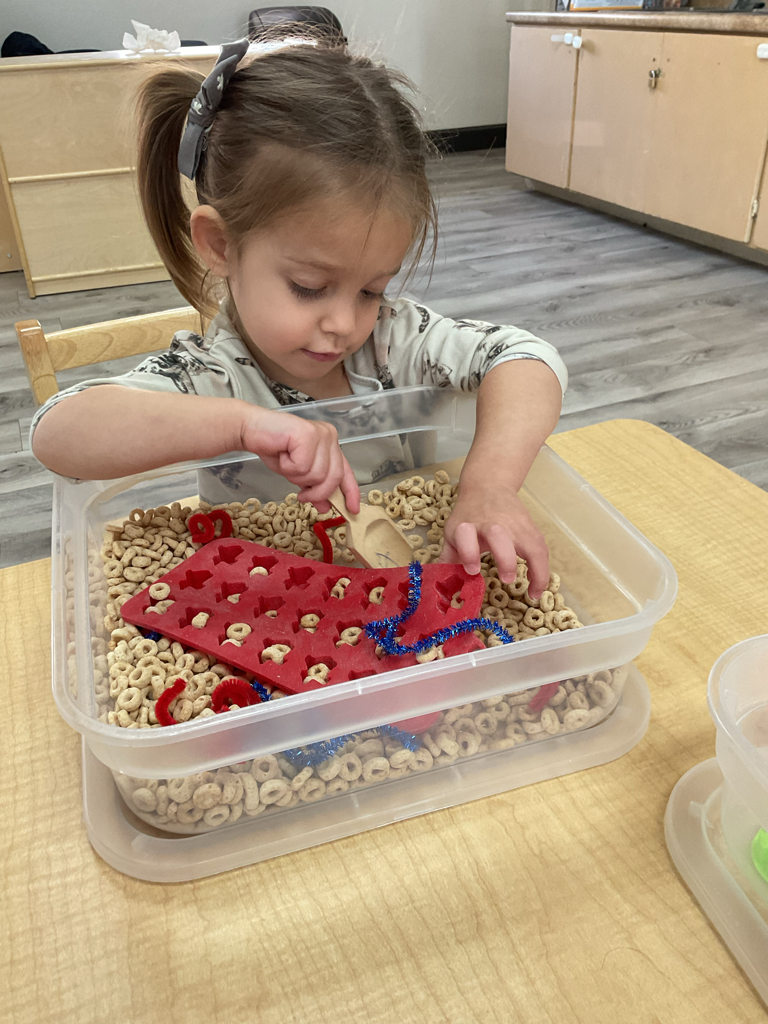
Did you know that children learn best through role modeling, repetition, and demonstrations? The next time you catch yourself telling your child how to do something- REMEMBER- SHOW DON’T TELL!
You may be familiar with your child’s ‘show and tell’ and the excitement or trepidation it brings to share something of interest with his class but are you familiar with ‘show don’t tell?
“The more carefully we cut away useless words, the more perfect will become the lesson.” – Maria Montessori
What is “Show Don’t Tell” in Montessori? Instead of verbally instructing your child, demonstrate the action slowly and silently, then let them try independently. Children learn through observation and repetition—not lectures.
4 things to be mindful of when teaching your child anything.
The next time you catch yourself telling your child what and how to do something, stop and bring your awareness to the following;
1. Children learn primarily through role modeling. They observe our every move and mimic our actions and behaviors to acquire their skills to be independent. Telling a child what to do is not likely to work as effectively as showing your child what you expect from him through your actions.
2. Children respond to positive directions and demonstrations. Instead of saying, ‘Johnny, don’t spill the milk’, adjust your approach to ‘Johnny, remember to hold the jug with two hands,’ and show him how. Bring awareness to the finer details of how to refine his actions.
3. Repetition is key. It takes some time for children to master skills to build neural pathways. Experience through repetition is essential as it helps in this process. You may need to repeat positively phrased instruction along with a demonstration a few times before your child will fully grasp what it is that you are trying to show him.
4. Children respond in a positive way when they feel good. Creating a safe space for your child to make mistakes and learn is essential. Encourage and support your child’s efforts rather than shame or reprimand him for ways he may not be doing things well. Help him become confident in his abilities by allowing him the opportunity for independence and reinforcing his successes.

Role modeling is key.
It is important to remember that if we expect our children to behave in a particular manner and not demonstrate this in our own lives, it is doubtful that your child will adopt this behavior. It is more likely that your child will start to mistrust or disrespect your instruction as there is an apparent disjoint between what you are saying and how you are behaving. For example, if you want your children to eat green vegetables but you do not, your child will begin to think that your instruction is not essential. If, however, you happily eat green vegetables regularly in front of your child, then your child will much more likely partake in them too.

Use clear positive instruction.
If you want your child to be aware of certain dangers and you find yourself saying, ‘Johnny, do not touch the stove,’ your child is likely to hear ‘touch’ and may do the very thing you are asking him not to do. It is much more effective to show him how to stand away from the stove and say, ‘Johnny, when you are in the kitchen, please stand away from the stove and keep your hands away from this plate as it is hot and can burn your fingers.’

Provide an opportunity for independence to build neural pathways.
Remember that 90% of a child’s brain develops by five years old. A child develops neural connections at an alarming rate from birth to five! Providing your child with ample opportunity to learn new skills will give your child the experience he needs to stimulate and formulate neural pathways in his brain. First, show him how and then allow him to do things independently. By the age of five, a child should be able to make infinite correlations, especially if he has had the opportunity through experience to repeat actions in various ways.

The Montessori Way to Teach your Child
Montessori devised a simple three-step process to help a child acquire a new skill. It is called the 3-period lesson and can easily apply at home too. Here is a simple three-step process to refine how you teach your child. Bare in mind the following quote from Montessori and follow the procedure below.
“But an adult, if he is to provide proper guidance, must always be calm and act slowly so that the child who is watching him can clearly see his actions in all their particulars.” – Maria Montessori
Step by Step: 3 Period Lesson
For example, if you would like your child to learn to make his bed in the morning, this is how one would show him in a Montessori way.
- Step 1: Name objects in the process.
For example, ‘Johnny, today I will show you how to make your bed. Let’s first look at the parts of your bed. This is a pillow; this is a pillowcase, this is a sheet etc.’
- Step 2: Recognition by playing games
The key is to make this step interactive and fun! Ask your child to point out the objects that you have just named. For example, ‘Johnny, can you put the pillow on your head? Can you climb under the duvet? Can you take the pillowcase off the pillow?’ If your child has not grasped the names, gently remind him and reinforce the lesson again. Do not correct him!
- Step 3: Recall by asking, ‘what is this?’
For example, ‘Johnny, do you remember the name of this?’ and point to an object. Questioning your child will give you a good indication of his listening skills and how well he has grasped the ‘lesson’.
Once you have been through this process of giving your child the language to all parts of the process, you can then demonstrate very slowly and carefully how to make his bed. Do this in silence and ask him if he would like a turn. Again, do not correct him if he has not done it right; smile and perhaps acknowledge something he did well. Re-demonstrate some other time by emphasizing the parts he is not doing correctly.
“The purpose of the three-period lesson is to help the child to better understand…and to allow you to see how well the child is grasping and absorbing what you are showing him.”– Elizabeth Hainstock
The best way to ‘show’ your child anything is through role modeling, so firstly, be mindful that you are demonstrating this in your life. Remember, a child needs ample opportunity to practice skills, so show him carefully and then let him do it independently. There is no right or wrong way, so relax and enjoy the learning process together.
Subscribe to Newsletter
Frequently Asked Questions
What is the Montessori 3-period lesson?
The Montessori 3-period lesson is a simple method to teach children new concepts or skills:
- Period 1 — Naming: Introduce the object or action (“This is a pillow”)
- Period 2 — Recognition: Interactive games to reinforce (“Can you put the pillow on your head?”)
- Period 3 — Recall: Ask “What is this?” to check understanding
This approach builds vocabulary and understanding through hands-on experience rather than repetition or drilling.
How do I teach my toddler without yelling or repeating myself?
Instead of telling your child what to do, show them. Demonstrate the action slowly and silently, then let them try independently. Use positive phrasing (“Hold the cup with two hands”) instead of negative (“Don’t spill”). Children learn primarily through observation and imitation, not verbal instruction. Expect to demonstrate multiple times—repetition builds neural pathways.
What does “show don’t tell” mean in Montessori education?
In Montessori education, “show don’t tell” means demonstrating actions for your child rather than giving verbal instructions. Children learn best through role modeling, repetition, and hands-on experience. When teaching any skill—from making a bed to pouring water—show the steps slowly and silently, then allow your child to practice independently.
At what age can I start using Montessori teaching methods at home?
You can start using Montessori methods from birth. Infants benefit from a language-rich environment and freedom of movement. Toddlers (12-36 months) are especially receptive to “show don’t tell” teaching for practical life skills like dressing, pouring, and cleaning up. The key is matching activities to your child’s developmental readiness and interests.
How do children learn best according to Montessori?
According to Montessori, children learn best through:
- Role modeling — they observe and imitate adult actions
- Hands-on experience — touching and manipulating real objects
- Repetition — practicing skills multiple times to build neural pathways
- Independence — doing things themselves rather than having adults do it for them
- A prepared environment — organized spaces with child-sized tools and materials
Why doesn’t my child listen when I tell them what to do?
Children process visual demonstrations more effectively than verbal instructions. When you say “don’t spill the milk,” your child often hears “spill” and may do exactly that. Instead, show them how to hold the cup with two hands and pour slowly. Also, children need repetition—it takes many demonstrations before a skill is mastered. Be patient and demonstrate again rather than repeating verbal instructions.
How do I teach my child to be more independent?
Create opportunities for independence by:
- Setting up your home with child-accessible items (low hooks, step stools, child-sized tools)
- Demonstrating tasks slowly and letting them try
- Allowing time for them to struggle and problem-solve
- Avoiding the urge to “fix” or do it for them
- Celebrating effort rather than perfection
By age 3-4, children can dress themselves, pour drinks, set the table, and clean up spills with proper guidance.
Programs offered at Edquisitive Montessori Plus include:
✔️Infants (10 Weeks – 18 Months)
✔️Toddlers (18 – 36 Months)
✔️Primary (3-6 Years)
✔️Kindergarten
✔️Mother’s Day Out
✔️Spanish Immersion / Dual Language
✔️After School Programs and Summer Camp (6 – 12 Years)
Music, Spanish, and Yoga are other programs included as part of the tuition.
Learn more about Inquiry-based Learning