More than ABCs and 123s. Our Montessori preschool develops the whole child—building the confidence, independence, and social-emotional skills that kindergarten teachers say matter most.
Did you know 40% of children start kindergarten unprepared? Research shows it’s not because they can’t count to 20—it’s because they lack the emotional skills to follow directions and work with others.
At Edquisitive Montessori, we don’t just teach letters; we teach life skills. Our inquiry-based lessons build the confidence and emotional regulation your child needs to thrive in a real classroom.
Our 2:25 ratio beats the State average (2:36), ensuring your child is never just a number.
Our preschool program develops all six domains that research shows matter for kindergarten success—not just academics:
Letter recognition, phonics, reading simple sentences, engaging in conversation, understanding that print conveys meaning.
Counting to 20+, sorting and classifying, shapes, simple addition and subtraction, measuring, one-to-one correspondence.
Pencil grip, scissors use, balance and coordination, personal care routines, safety awareness.
Making friends, taking turns, expressing emotions with words, conflict resolution, respecting others, self-confidence.
Curiosity and questioning, making predictions, understanding living vs. non-living, exploring art and music, dramatic play.
Persistence, concentration, flexibility, inventiveness, curiosity, independent learning—skills that predict long-term success.
Our Montessori primary classroom is designed as a three-year cycle for children ages 3-6. This means your child’s teacher knows them deeply—their strengths, challenges, and unique learning style. No time lost building new relationships every year. No slipping through the cracks.
The first two years prepare for the kindergarten year, when everything falls into place. Third-year students become classroom leaders, mentoring younger children while their own skills skyrocket.
Our proprietary edScription curriculum combines authentic Montessori methods with Reggio Emilia-inspired inquiry and project-based learning. Children don’t just learn what to think—they learn how to think.
When a child asks why leaves change color, we don’t just answer—we investigate together. We collect leaves, sort them, observe them over time. That single question touches science, math, language, and critical thinking.
When it comes to building independence, no approach does it better than Montessori. Every part of the curriculum prepares children to take ownership of their development. Teachers are trained to step back, giving children the opportunity to grow—and even make mistakes. Independent children grow up feeling empowered and confident in their ability to make sound choices. An independent child is ready for any new adventure—especially kindergarten.
Everything below is included in tuition—no extra fees, no add-ons.
Native Spanish-speaking teachers provide daily immersion. Children develop bilingual foundations through songs, stories, and vocabulary. Pre-K students use the Estrellita reading program.
Weekly sessions teach body awareness, emotional regulation, and focus—skills that directly support classroom learning and kindergarten readiness.
Dedicated space for developing gross and fine motor skills, balance, coordination, and body control—building the physical foundations for writing and learning.
Weekly hands-on experiments encourage questioning, predicting, and discovering through age-appropriate investigations. Children learn the scientific method naturally.
Songs, rhythm, instruments, and movement—developing listening skills, memory, pattern recognition, and creative expression through musical exploration.
By kindergarten, most Edquisitive children are reading and writing in both English and Spanish using Montessori phonics and the Estrellita program.
Our Montessori preschool curriculum covers five core areas, all taught through hands-on, child-led exploration:
Activities like pouring, washing, dressing, and cleaning develop fine motor skills, concentration, and independence. Children learn to care for themselves, their environment, and each other.
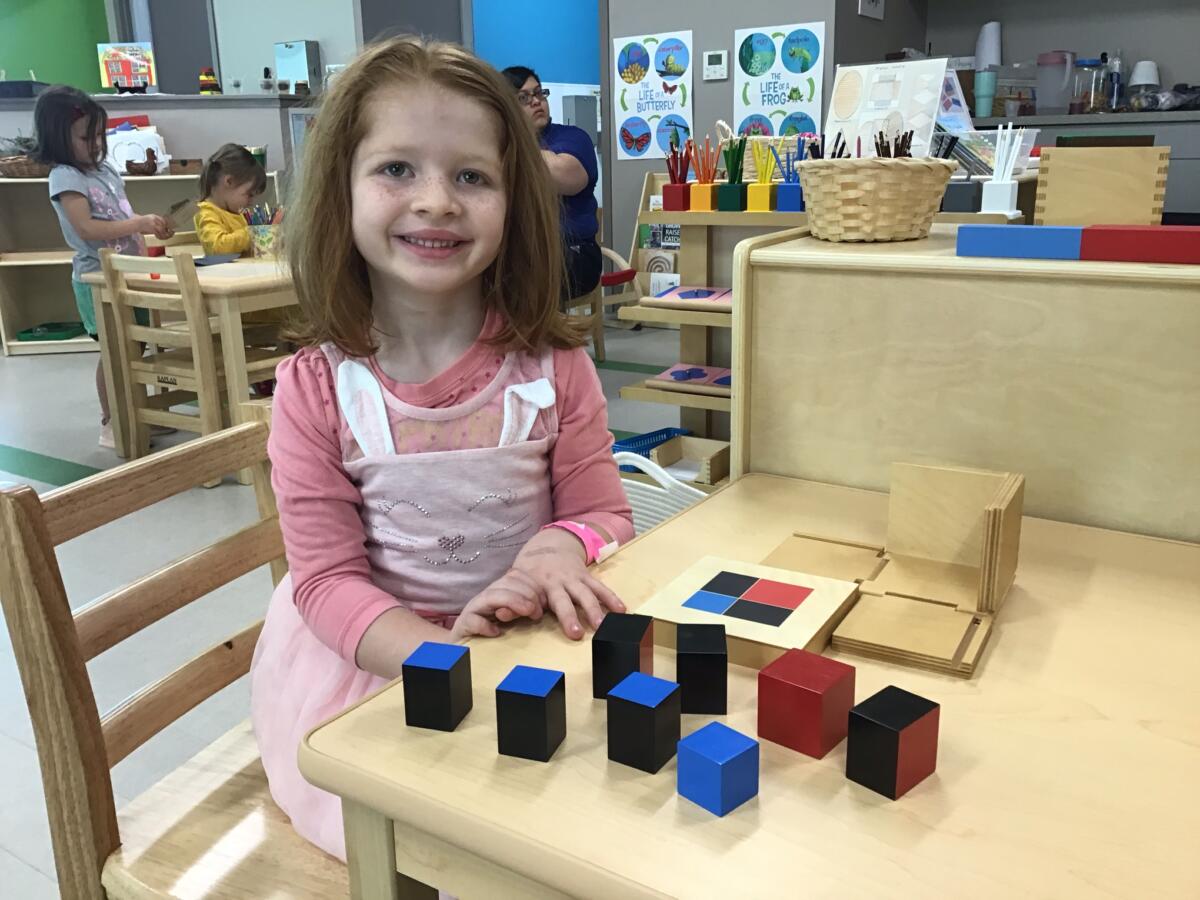
Hands-on materials engage all five senses, helping children develop observation, discrimination, and categorization skills. These concrete experiences lay the foundation for abstract learning.
Children don’t memorize math—they experience it. Using Montessori materials like golden beads and number rods, children develop confidence with counting, place value, and operations into the thousands.
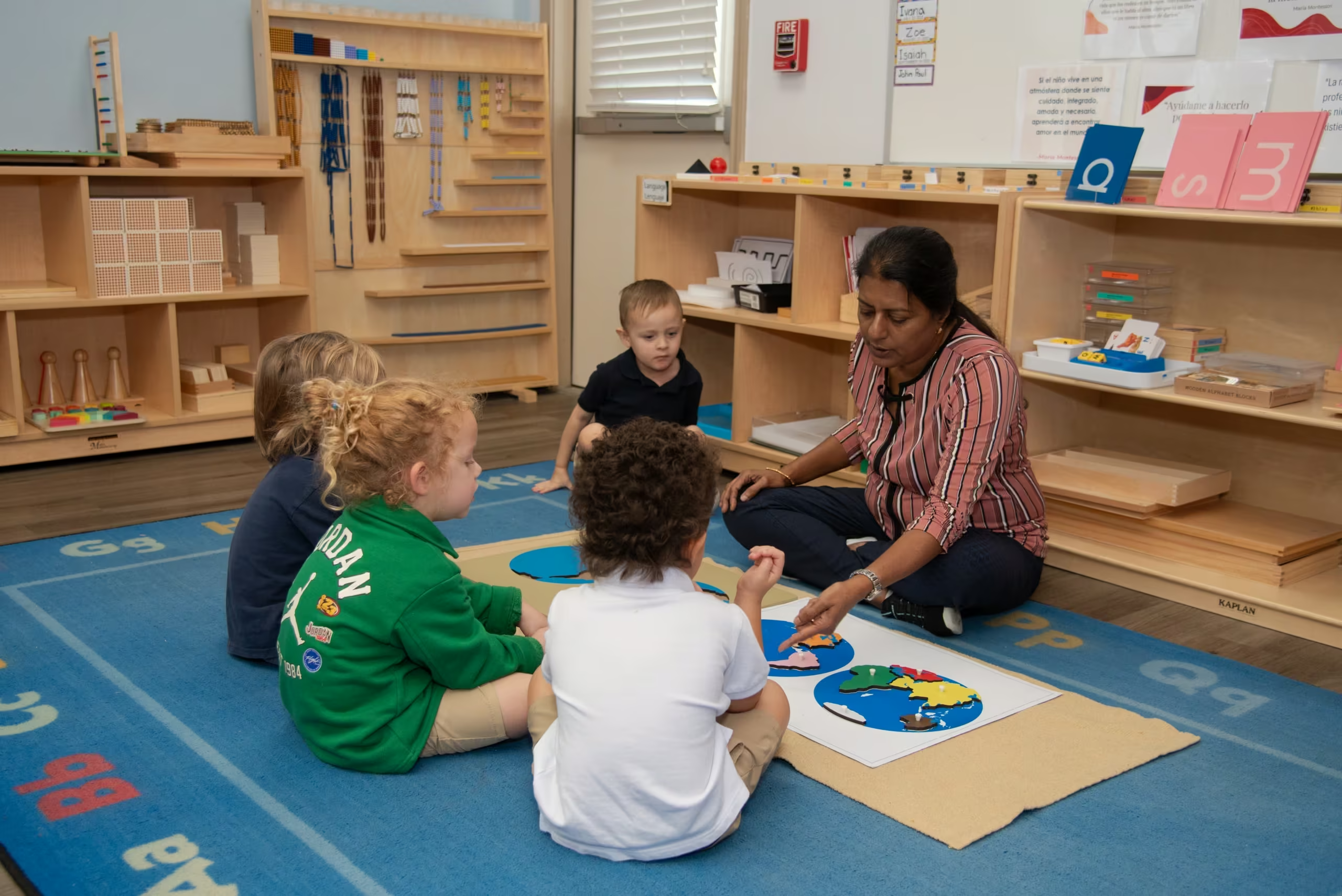
From phonetic sounds to reading and writing, our language program builds literacy step by step. Children trace sandpaper letters, build words with the moveable alphabet, and progress to reading and writing—in English and Spanish.
Geography, history, botany, zoology, and science encourage exploration and observation. Children learn through puzzle maps, plant experiments, animal classification, and cultural celebrations.
Spanish, Music, and Yoga lessons are included as part of the daily program.
| Time | Activity |
|---|---|
| 6:30 – 8:00 | Extended Care |
| 8:00 – 8:30 | Free Choice Activities |
| 8:30 – 10:00 | Breakfast & Montessori Independent Work Period |
| 10:00 – 10:30 | Elective Period (Spanish, Music, Yoga) |
| 10:30 – 11:00 | Montessori Independent Work Period |
| 11:00 – 11:30 | Playground |
| 11:30 – 12:00 | Montessori Independent Work Period |
| 12:00 – 12:30 | Lunch |
| 12:30 – 2:00 | Nap / Montessori Work Period (1-on-1 lessons) |
| 2:00 – 3:00 | Montessori Independent Work Period |
| 3:00 – 3:30 | Playground |
| 3:30 – 6:30 | Extended Care |
Why long work periods matter: Children need uninterrupted time to achieve deep concentration. Our 90-minute work blocks allow children to become fully absorbed in their work—building the focus and persistence that kindergarten teachers consistently say children lack.
By kindergarten, Edquisitive children typically demonstrate:
Our Montessori primary classroom welcomes children aged 3 to 6 years old, encompassing both preschool and kindergarten. This mixed-age environment allows younger children to learn from older peers while older children develop leadership and mentoring skills.
Yes. Our Pre-K curriculum emphasizes all six domains of readiness—not just academics. By kindergarten, most children are reading, writing, working with large numbers, and possess strong self-regulation and social skills. Learn more about kindergarten readiness →
Inquiry-based learning encourages children to ask questions, explore materials, and make connections through hands-on experiments and real-world problem-solving. Instead of memorizing facts, children learn how to learn. Explore inquiry-based learning →
All enrichments are included with no extra fees: Spanish immersion, music, yoga, Science Fridays (STEM), and our Movement & Motor Skills Lab. We believe these experiences are essential—not extras.
Mixed-age classrooms are a cornerstone of Montessori education. Younger children learn from older peers who serve as role models, while older children reinforce their learning by teaching. This creates a collaborative, family-like community where each child progresses at their own pace.
Yes. Native Spanish-speaking teachers provide daily immersion in all classrooms. Pre-K students also use the Estrellita Spanish reading program. Read our Spanish Immersion FAQ →
Yes. We accept CCS (Child Care Services) and CCA (Child Care Aware) subsidies at all campuses. Families receiving assistance have access to our full program with all enrichments included. View tuition and payment options →
Schedule a tour and watch kindergarten readiness happen in real time.
One approach, multiple neighborhoods—each with its own sense of community.