Engaging, inquiry-inspired care that extends learning beyond the classroom.
If your child has been in our Montessori program, you’re facing a decision: keep them for the kindergarten year, or send them to public school?
Here’s what we’ve learned after graduating hundreds of kindergarteners: the third year of the Montessori cycle isn’t just “another year” — it’s the year when everything your child has been building falls into place. Maria Montessori called it the year children “skyrocket” into complex learning. We see it happen every single year.
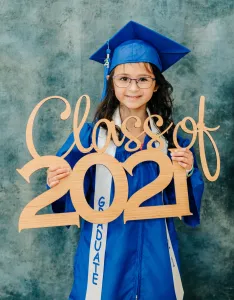
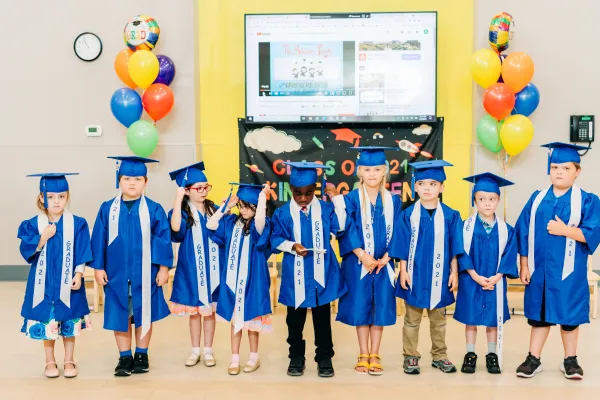
The first two years lay the foundation. The kindergarten year is the payoff — when your child becomes a leader, a mentor, and a confident learner ready for anything elementary school throws at them.
The Montessori primary classroom is designed as a three-year cycle. Here’s how it works:
Children watch, absorb, and learn routines. They’re introduced to materials and begin building foundational skills while observing older peers.
Children practice and deepen skills. They work with increasing independence and begin mastering concepts introduced in year one.
This is kindergarten. Children consolidate learning, mentor younger peers, and experience rapid academic and social growth. Everything clicks.
“From the age of three till six, being able to now tackle his environment deliberately and consciously, he begins a period of real constructiveness.” — Maria Montessori, The Absorbent Mind
Your child’s teacher already knows them exceptionally well — their strengths, challenges, learning style, and personality. There’s no time lost building new relationships. No risk of “slipping through the cracks” in a new environment with 20+ unfamiliar students.
As the oldest in the mixed-age classroom, kindergarteners become role models and mentors. Teaching younger children reinforces their own learning while building confidence, empathy, and communication skills that will serve them for life.
This is the year skills “click.” Children who’ve spent two years building foundations suddenly read chapter books, write stories, and grasp math concepts that surprise their parents. The consolidation of learning is remarkable to witness.
No educational approach builds independence like Montessori. By kindergarten, children own their learning — making choices, solving problems, managing frustration. They leave feeling capable and confident, ready for any new adventure.
True readiness isn’t just academics. Research shows social-emotional skills predict success better than knowing letters and numbers. Our program develops all six domains:
Reading and writing simple sentences, letter-sound associations, rich vocabulary, book handling skills
Counting to 100+, simple addition and subtraction, sorting, classifying, measuring, shapes, one-to-one correspondence
Balance, coordination, pencil grip, scissors skills, self-care routines, understanding basic safety
Managing emotions, making friends, taking turns, resolving conflicts with words, showing empathy and respect
Curiosity, asking questions, making predictions, recording observations, exploring art and music
Curiosity, persistence, focus, flexibility, problem-solving, functioning as an independent learner
Our full-day program provides structure and academic rigor to prepare for elementary school — no naps, more focus time, greater expectations:
| Time | Activity |
|---|---|
| 7:00 – 8:00 AM | Arrival & Breakfast |
| 8:00 – 11:30 AM | Montessori Work Cycle — Extended, uninterrupted time for deep work in language, math, sensorial, and practical life |
| 11:30 AM – 12:00 PM | Outdoor Play & Gross Motor |
| 12:00 – 12:45 PM | Lunch & Community Time |
| 12:45 – 1:30 PM | Read Aloud & Quiet Activities |
| 1:30 – 3:00 PM | Afternoon Work Cycle — Small group lessons, enrichments, project work |
| 3:00 – 3:30 PM | Snack & Story Time |
| 3:30 – 4:30 PM | Outdoor Play & Exploration |
| 4:30 – 6:00 PM | Extended Day — Free choice activities and pickup |
Enrichments included: Spanish, Yoga & Mindfulness, Music, Motor Skills Lab, and Science Fridays — all part of tuition, not extra fees.
| Edquisitive Montessori | Traditional Public School | |
|---|---|---|
| Class Size | Mixed-age, smaller ratios | 20-25 same-age students |
| Teacher Relationship | Same teacher for 3 years | New teacher, new classroom |
| Learning Pace | Individualized progression | Whole-group instruction |
| Work Time | 3-hour uninterrupted work cycles | 20-30 minute rotations |
| Child’s Role | Leader & mentor to younger peers | Youngest in building |
| Assessment | Observation-based, portfolio | Tests and grades |
| Independence | High — self-directed learning | Teacher-directed activities |
Yes! Our Montessori kindergarten is a full-day program (6:30 AM – 6:30 PM) with more structure and academic rigor than preschool. Unlike younger classes, kindergarteners don’t nap — they use that time for extended learning, enrichments, and project work.
Kindergarten is the pinnacle of the three-year Montessori cycle — this is when everything your child has learned falls into place. Third-year students experience rapid academic and social growth as they consolidate their knowledge and tackle more complex learning. Your child’s teacher already knows them exceptionally well, so there’s no time lost building new relationships. Children who complete the full cycle leave with confidence, independence, and a genuine love of learning.
In the mixed-age classroom, kindergarteners serve as role models and mentors for younger classmates. Teaching others reinforces their own learning — when you can explain something to a 3-year-old, you truly understand it. This leadership role builds confidence, empathy, and communication skills while creating a sense of responsibility and accomplishment.
Absolutely. Our kindergarten graduates consistently enter first grade ahead of peers academically. But more importantly, they enter with the executive function skills — focus, persistence, self-regulation, independence — that research shows predict long-term success better than academic skills alone. They know how to learn, not just what they’ve memorized.
Yes, we welcome new families for the kindergarten year. Children who are new to Montessori adapt quickly — they learn the routines from observing their peers, just as younger children do. We’ll work with you to assess your child’s skills and ensure a smooth transition.
After kindergarten, children transition to first grade at the school of your choice — public, private, charter, or homeschool. We provide transition support and documentation of your child’s progress. Many families continue with our After School Program through age 12.
Schedule a tour and watch kindergarteners lead, learn, and thrive.
One approach, multiple neighborhoods—each with its own sense of community.