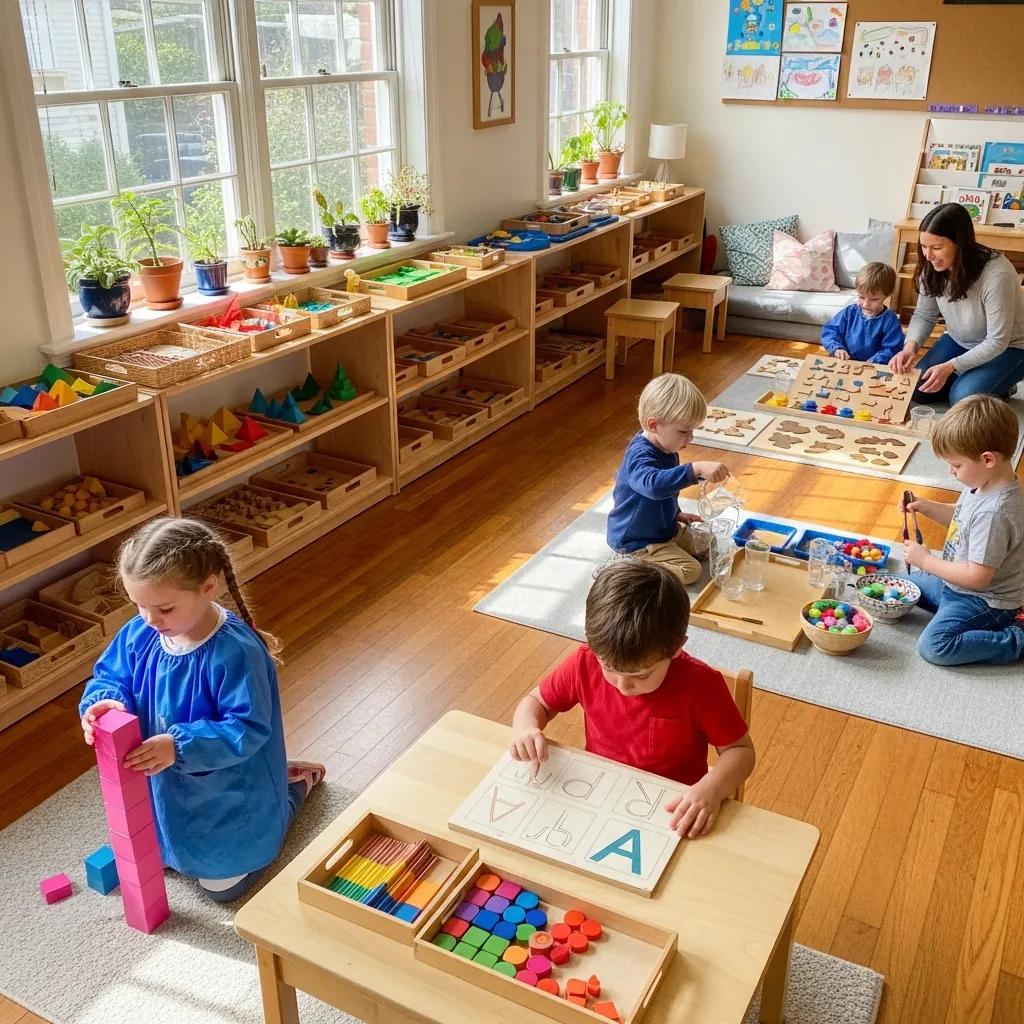
You want more than daycare. You want a place where your child doesn’t just sit and wait — where they wake up excited to go to school, where they build real confidence, and where who they are as a person is nurtured from day one. Montessori education was designed exactly for that — and parents across San Antonio and Boerne are discovering why it works.
Traditional preschool asks children to sit still and follow along. Montessori flips that. Here’s what that means for your child, in practice:
Montessori classrooms are warm, calm, and beautifully arranged — designed so children feel safe to explore. When children feel secure, their brains open up to learning. That’s not a philosophy, it’s neuroscience.
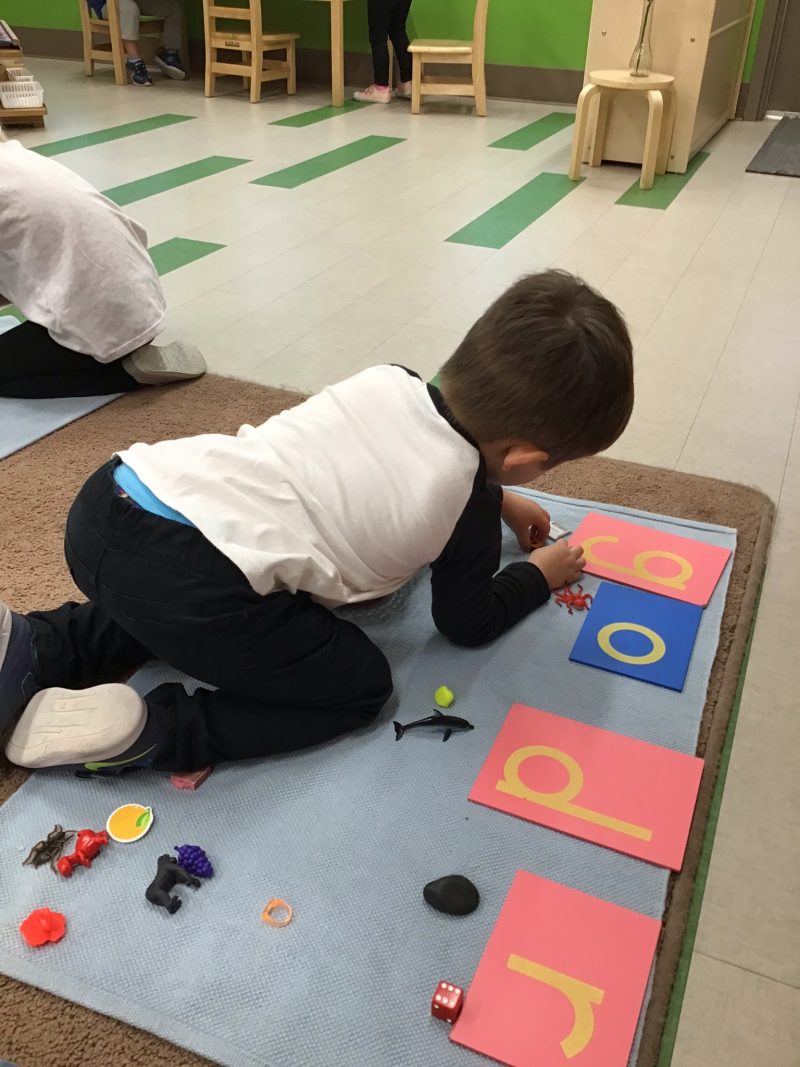
Children choose their activities based on what genuinely interests them. This isn’t free play — it’s intentional. When a child chooses their work, they build intrinsic motivation: the drive to learn that no worksheet can manufacture.
Our guides (not “teachers”) observe each child continuously and tailor support to their specific pace and strengths. Your child isn’t compared to the class — they’re compared to their own best self.
| At a Traditional Preschool | At Edquisitive Montessori |
|---|---|
| Teacher-directed lessons for the whole class | Child-chosen work guided by a trained educator |
| Same-age peer groups only | Mixed-age classrooms where older kids mentor younger |
| Rote memorization & worksheets | Hands-on materials that make concepts tangible |
| Teacher as authority & information source | Guide as observer, facilitator, and encourager |
| Sit still and listen | Move, explore, repeat — at their own pace |
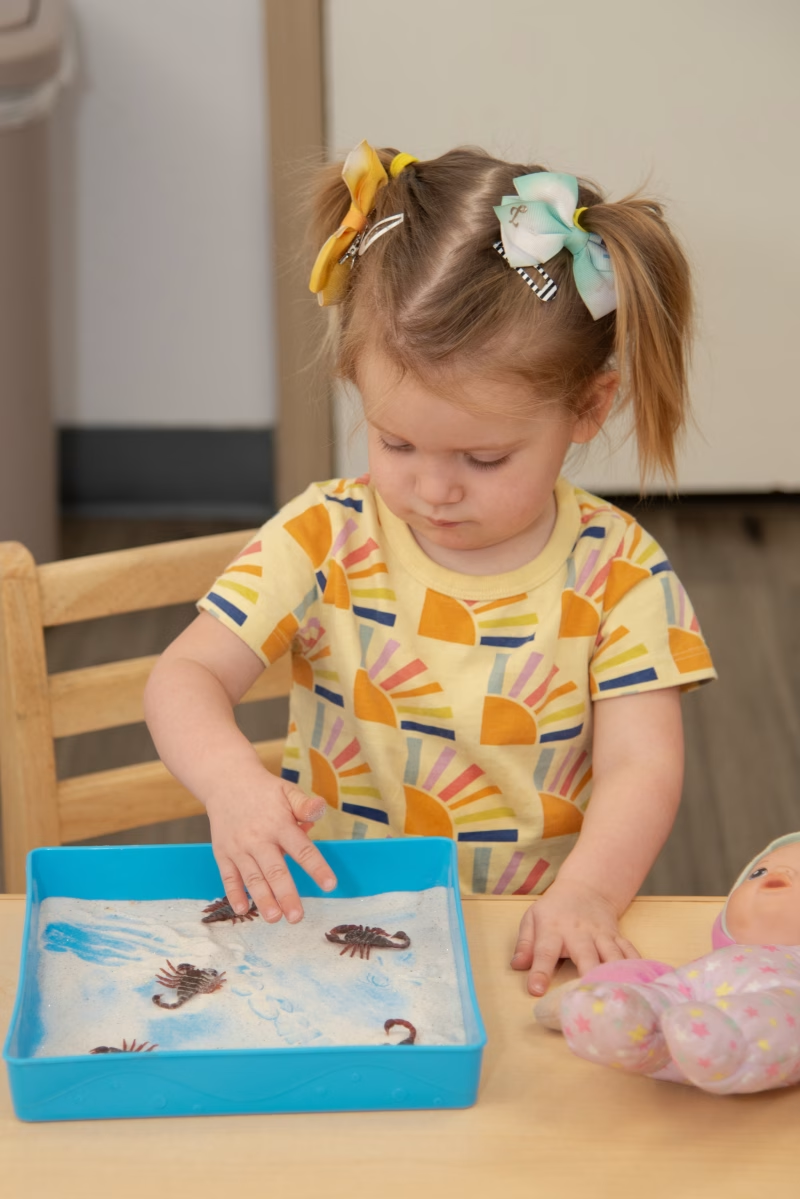
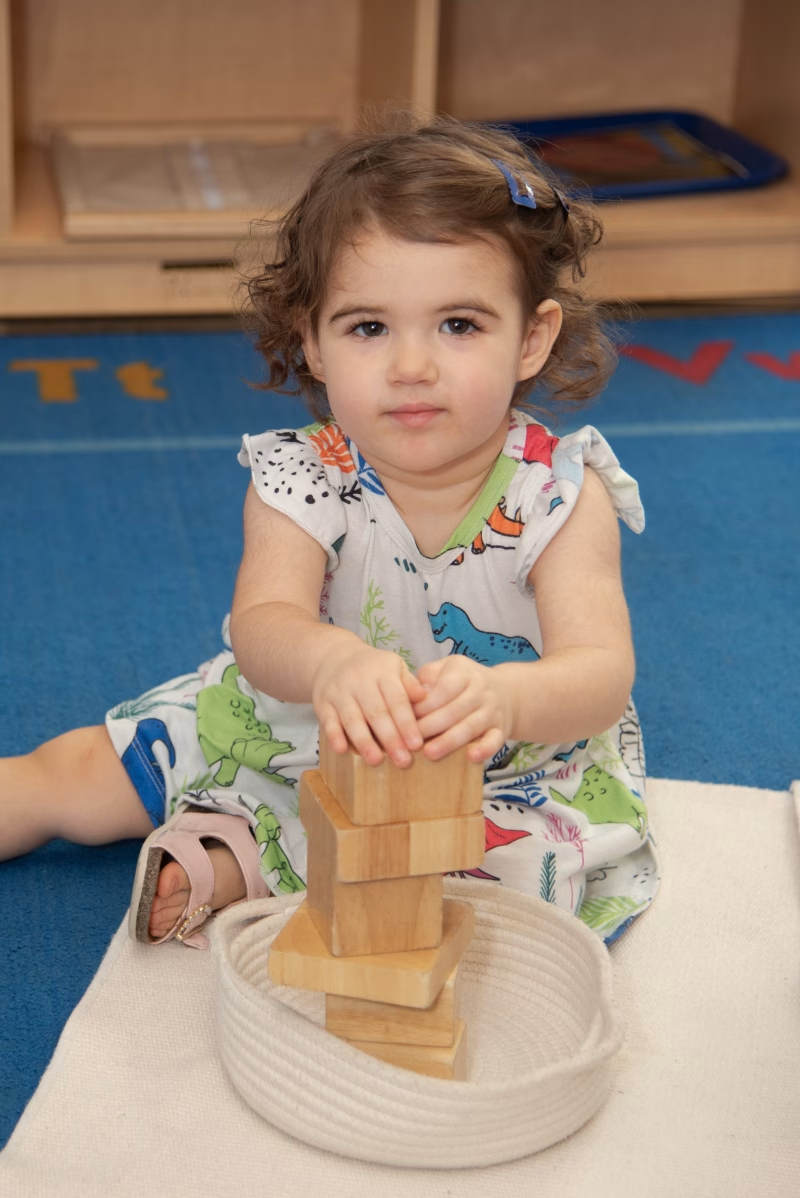
Watch a child pour their own water, fold their own napkin, or carefully carry a tray across the room — and you’re watching confidence being built in real time.
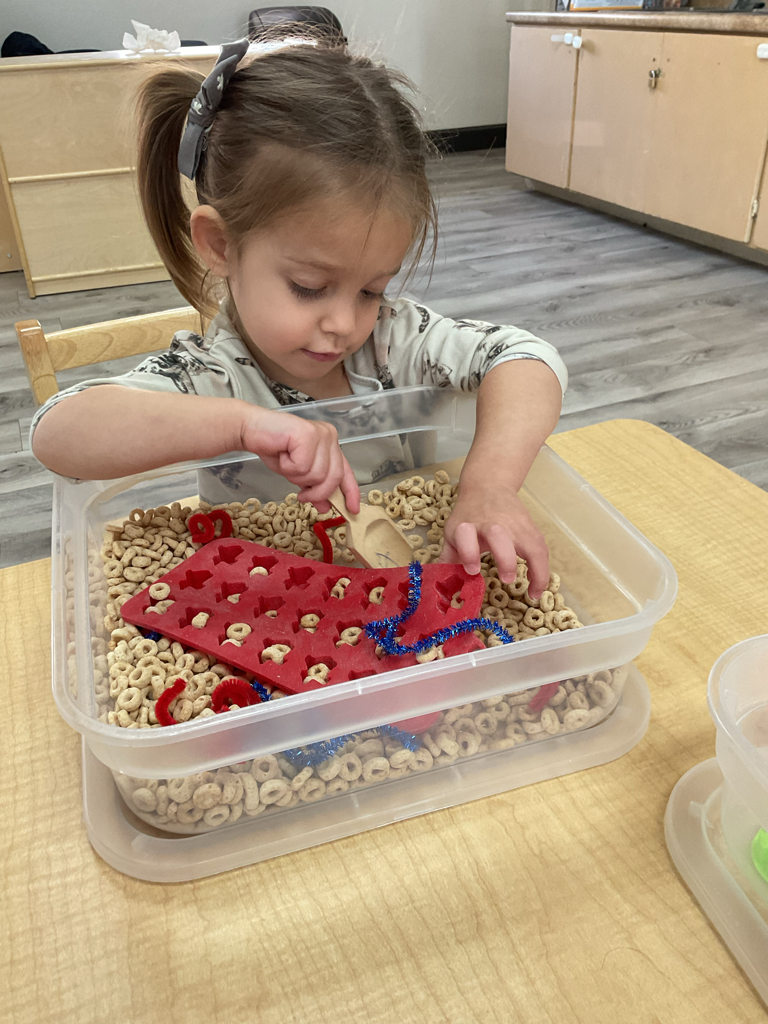
These aren’t chores. They’re Practical Life activities — a core part of the Montessori curriculum that develops fine motor skills, focus, self-regulation, and a genuine sense of capability that children carry with them for life.
Children also choose their own activities throughout the day — which means they’re building decision-making muscles before kindergarten even begins.

“When children are given freedom in a prepared environment, they feel happy and motivated toward a specific skill or knowledge in their sensitive period. Repetition has a key role in enhancing focused attention, mental strength, and the ability to grasp and understand.”
— AG Vatansever, A Way to Teach Practical Life Skills in Special Education: Montessori Pedagogy, 2019
“Before Edquisitive, my daughter would cry every morning. Within two weeks at Montessori she was asking to go on weekends. I’ve never seen a child so proud of herself.”
— Edquisitive Parent, Stone Oak Campus ⭐⭐⭐⭐⭐
For a deeper comparison, see our full guide to Montessori vs traditional preschool in San Antonio.”
We offer free, personalized tours at all four of our campuses in San Antonio and Boerne. Spots fill quickly — especially for our infant and toddler programs.
No commitment required. Tours available Mon–Fri at all campuses.
Most preschool programs focus on letters and numbers. Montessori focuses on the whole child — because a child who knows themselves, regulates their emotions, and works well with others will outperform on every metric that matters: in school, in relationships, and in life.
Hands-on materials develop critical thinking, problem-solving, and the ability to focus — all before kindergarten.
Children learn to name feelings, regulate reactions, and show empathy — skills that predict success better than IQ alone.
Mixed-age classrooms teach cooperation, conflict resolution, and the leadership skills that come from mentoring younger peers.
“Montessori’s key ideas — holistic development, learning through play, the prepared environment, and the importance of parents — create an interconnected foundation for children’s development in the critical 0–5 window.”
— The Influences From Montessori to the Early Years Children, 1952 / reviewed 2024
“Our son had trouble with big emotions. After six months at Edquisitive, his kindergarten teacher told us he was one of the most emotionally mature kids in her class. We were floored.”
— Edquisitive Parent, Fair Oaks Campus ⭐⭐⭐⭐⭐
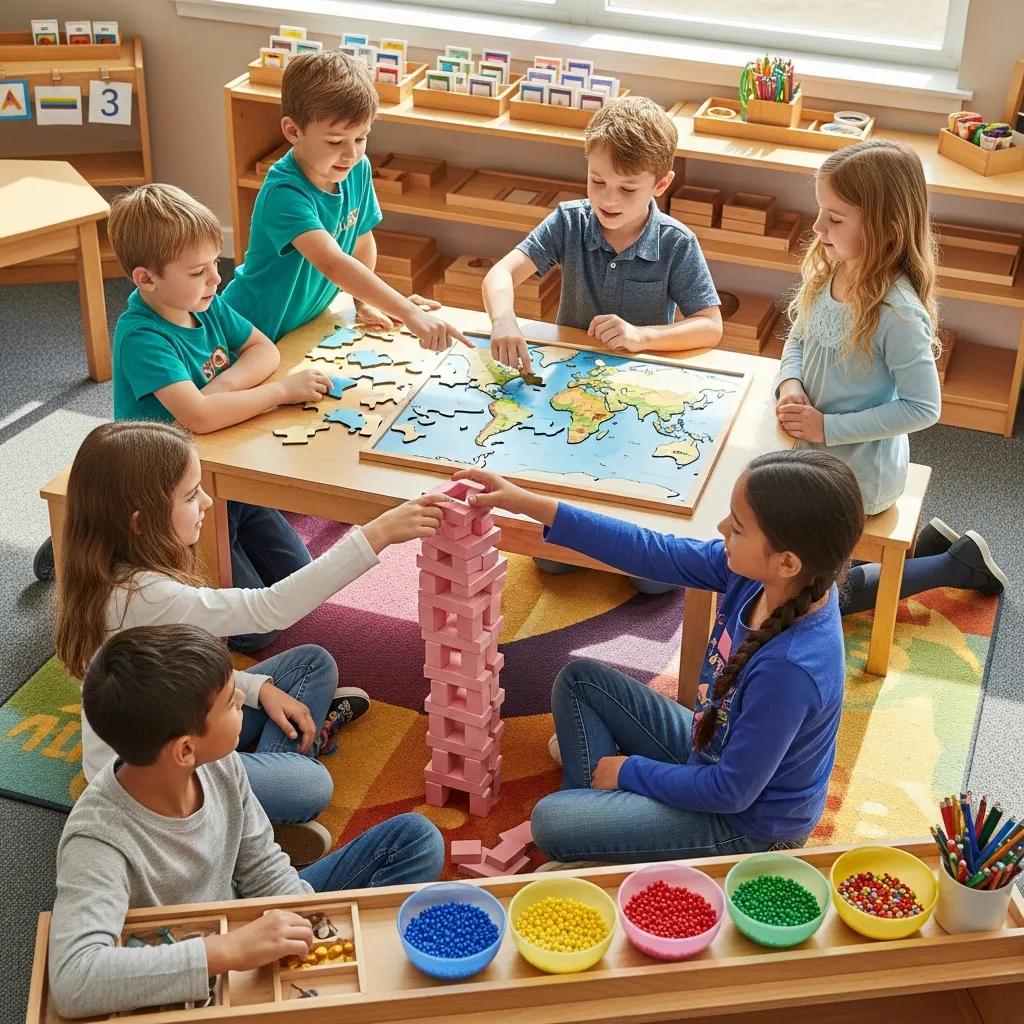
In our mixed-age classrooms, a five-year-old teaching a three-year-old how to button a jacket isn’t a distraction — it’s the curriculum working exactly as designed.
Children learn cooperation, patience, leadership, and conflict resolution naturally — not from a poster on a wall, but from real daily interactions with children at different stages.
These are the skills that make someone a great teammate, a compassionate leader, and a trusted friend. They start here.
We hear this consistently from parents across our four campuses. Here’s what they say made the difference:
Because children explore concepts hands-on — not through memorization — the knowledge becomes truly theirs. It transfers. It generalizes. It lasts.
When a child chooses their own work and succeeds at it daily, school becomes the place they want to be. That love of learning is the most important thing we can give them.
At Edquisitive, parents aren’t bystanders. You’re partners. We offer workshops, events, and ongoing communication so you always know what’s happening — and why.
“Montessori principles center on respect for the individuality of children and the belief that children have a natural capacity to learn. Children are given responsibility to manage their time and activities, with assessment focused on individual development rather than comparison between children.”
— M. Maemonah, Epistemology of Early Childhood Education from the Montessori View, 2024
“We toured three preschools. The moment we walked into Edquisitive, our daughter ran into the room and didn’t look back. That told us everything we needed to know.”
— Edquisitive Parent, Medical Center Campus ⭐⭐⭐⭐⭐
The best way to understand Montessori isn’t to read about it — it’s to see your child in it. Here’s how easy it is to get started:
We have four campuses across San Antonio and Boerne: Fair Oaks, Stone Oak / Spanish Grove Academy, Northwest Military, and Medical Center / Little Red Caboose. We serve children from 10 weeks through age 5.
Schedule a personalized tour at your preferred campus. You’ll walk through the classroom, meet your child’s future guide, and have every question answered. No pressure. No obligation.
After your tour, if Edquisitive feels right, our admissions team walks you through a simple application. We also accept CCS childcare subsidies and military childcare benefits — so more families can access a Montessori education.
FREQUENTLY ASKED QUESTIONS
Montessori preschool programs offer three distinct advantages over traditional early childhood education. First, a nurturing environment — classrooms are warm, calm, and beautifully arranged so children feel safe to explore and take risks. Second, child ownership of learning — children choose activities that genuinely interest them, building intrinsic motivation that no worksheet can manufacture. Third, personalized attention — our guides observe each child continuously and tailor support to their specific pace and strengths, so no child is compared to the class average. At Edquisitive Montessori, these principles are embedded across all four of our San Antonio and Boerne campuses.
Montessori builds independence through self-directed learning and practical life skills. Children are given the freedom to choose their activities each day, which develops decision-making and self-reliance from a very young age. They also engage in hands-on tasks — pouring, cleaning, organizing, preparing snacks — that build real confidence and a genuine sense of responsibility. This isn’t symbolic play; it’s a child discovering they are capable. Research confirms that when children are given freedom in a prepared environment, they become deeply motivated and develop focused attention through natural repetition.
The differences are fundamental, not cosmetic. Traditional early childhood programs follow a rigid, teacher-directed curriculum where all children do the same thing at the same time. Montessori classrooms are structured around each child’s individual interests and developmental stage. Learning happens through hands-on exploration rather than rote memorization. Classrooms feature mixed-age groups — typically spanning three years — so younger children learn from older peers while older children reinforce their knowledge by teaching. And instead of an authority figure at the front of the room, Montessori guides observe, facilitate, and support without directing.
The Montessori philosophy is built on the belief that education must address the whole child — intellectually, emotionally, socially, and physically. Academic learning is never treated in isolation. Children engage in hands-on activities that simultaneously develop critical thinking, fine motor skills, emotional regulation, and social cooperation. Maria Montessori’s research identified the 0–5 window as the most critical period for this integrated development, which is why starting early matters so much. At Edquisitive, our curriculum is designed to nurture all four dimensions of development from infancy through Pre-K.
Child-centered learning means the curriculum follows the child — not the other way around. Rather than a fixed lesson plan delivered to the whole class, Montessori guides observe each child’s interests, current abilities, and developmental stage, then introduce materials and activities matched specifically to that child. This allows children to engage deeply with subjects that genuinely fascinate them, leading to richer understanding and longer retention. Children are also given responsibility for managing their own time and activities — a skill that serves them for life. Assessment focuses on individual growth, not comparison to peers.
Montessori classrooms are naturally structured for social and emotional development. Mixed-age groups create daily opportunities for cooperation, mentorship, conflict resolution, and empathy — not as a special lesson, but as a natural part of the school day. Children learn to share space, negotiate disagreements, and look out for younger classmates. The emphasis on emotional intelligence helps children understand their own feelings and recognize the feelings of others, building the interpersonal skills that predict lifelong success in relationships, workplaces, and communities.
Parents choose Montessori for toddlers because it aligns with how toddlers actually develop. Between ages 1–3, children are in sensitive periods for language, movement, and order — and Montessori classrooms are specifically designed around these drives. The individualized approach means no child is pushed ahead or held back. Hands-on activities make learning genuinely enjoyable rather than stressful. And the emphasis on social skills means children enter kindergarten not just academically ready, but emotionally and socially prepared. At Edquisitive, our toddler program is consistently our most in-demand — families often join our waitlist before their child turns one.
Early childhood Montessori programs deliver benefits across every dimension of development. Cognitively, children build critical thinking, problem-solving, and focused attention through hands-on materials. Socially and emotionally, they develop empathy, cooperation, and self-regulation in mixed-age environments. Academically, research consistently shows Montessori children perform as well or better than peers from traditional settings — often entering kindergarten significantly ahead in literacy and executive function. And as a community, Montessori schools foster strong family involvement and belonging that benefits children well beyond the classroom.
Montessori education treats parents as partners, not spectators. Families are actively encouraged to participate in their child’s learning journey — through classroom observations, parent workshops, school events, and ongoing communication with guides. This collaboration creates a genuine community where families feel connected to the school and to each other. At Edquisitive, we host regular parent education events and maintain open communication across all four campuses, because we know that when families and educators are aligned, children thrive faster and more deeply.
Enrolling at Edquisitive Montessori starts with a free campus tour. Begin by researching which of our four campuses — Fair Oaks, Stone Oak / Spanish Grove Academy, Northwest Military, or Medical Center / Little Red Caboose — is most convenient for your family. Then schedule a personalized tour directly on our website. During the tour you’ll walk through the classroom, meet your child’s future guide, and have every question answered with no pressure and no obligation. After the tour, if Edquisitive feels right, our admissions team guides you through a straightforward application process.
The Edquisitive enrollment process has three simple steps. First, complete a free tour of your preferred campus so you can experience the environment firsthand and ask questions. Second, submit your enrollment application — our team will walk you through it and it typically takes less than 15 minutes. Third, once your application is reviewed, you’ll receive an acceptance letter and enrollment agreement outlining the program details. We accept CCS childcare subsidies and military childcare benefits, so more families can access a Montessori education regardless of budget. Spots fill quickly, especially for infant and toddler classrooms, so we recommend starting the process as early as possible.
The best way to understand Montessori is to see it in action. Edquisitive offers personalized campus tours Monday through Friday at all four locations — each tour is tailored to your family’s specific questions and interests. Beyond tours, we regularly host parent workshops on Montessori principles, practical life activities you can do at home, and how to support your child’s development during the critical 0–5 window. Community events throughout the year give families a chance to connect with each other and with our educators in a relaxed, welcoming setting. All of these experiences are designed to help you feel confident in your decision — and connected to our community from day one.
COGNIA ACCREDITED · TEXAS RISING STAR 4-STAR · ALL FOUR CAMPUSES
Tour spots fill quickly — especially for our youngest learners (10 weeks – 18 months). Reserve yours today and see what a Montessori education looks and feels like in person.
📍 Fair Oaks · Stone Oak · Northwest Military · Medical Center
Serving families from 10 weeks to 5 years old · CCS & Military Benefits Accepted
Kindergarten registration is right around the corner—Boerne ISD, NISD, NEISD, and other San Antonio Area school districts opens enrollment in March 2026, and if you’re […]
Quick Answer: Is Elf on the Shelf Real? No, the Elf on the Shelf is not real. It’s a holiday tradition where parents move a […]
The Deep Work of Toddlerhood—And the Special Teachers It Demands If you’re a parent of a toddler, you know the feeling: they are non-stop. Their […]
One approach, multiple neighborhoods—each with its own sense of community.